

China: the journey that calls into question everything you thought you knew
There are countries you can picture before you even set off. Close your eyes and precise, almost stereotyped images come to mind: a monument, a typical dish, a landscape. With China something different happens. You set off with a fairly clear idea and come home with the feeling that no photograph, no documentary and no book has ever really managed to tell its story as it deserves.
Because China is not a country that can be summed up in a single well-defined image. It is a place that changes constantly, not only in its landscape but in the way it forces you to look at it.
This is the thread running through our itinerary: a journey through imperial cities, sacred mountains, futuristic metropolises and archaeological sites unique in the world, but one that, above all, tells of a civilisation able to reinvent itself without ever losing touch with its roots.
The Great Wall: the monument everyone knows… but almost no one has really understood
The Great Wall is probably China’s most famous symbol. And yet, precisely because we have always seen it in books and documentaries, we risk taking it for granted. The first surprise is that what we call the “Great Wall” was never a single wall. It is the result of almost two thousand years of building, demolition, extension and reconstruction. Every dynasty added its own stretch, adapting it to the terrain and the materials available. In the mountains around Beijing, stone and brick prevail; in the desert regions of the west there are still sections built of rammed earth and bundles of reeds. It is like leafing through a history book written in different materials. The Juyongguan section, included in our Wonders of China itinerary, was famous for its strategic importance. Anyone wishing to reach the capital from the north was all but forced to pass through this narrow natural corridor. For this reason it was fortified until it became one of the best-defended points in the entire system.
Then there is a detail that reveals just how sophisticated this enormous defensive work was. The towers were not only for watching the enemy: they were a genuine communication system. By day smoke signals were used, while at night a few fires were enough to relay a message from one tower to the next in surprisingly quick time. A system as simple as it was effective, when you consider that all this took place many centuries before the invention of the telegraph.
The Forbidden City: where every detail had a meaning
Entering the Forbidden City means stepping into a vision of the world very different from our own. It is not only the largest imperial complex in existence: it is a place built to convey a precise message. Many know the legend of the 9,999 rooms, but few know why this number became so famous. In Chinese culture nine was the emperor’s number, while ten thousand symbolised celestial perfection. No earthly sovereign could equal Heaven, and so tradition has it that the palace had to stop, symbolically, one room short.
Strolling through the courtyards you notice another peculiarity: trees are surprisingly few in the great inner squares. One explanation, put forward by several scholars, is that the open spaces made it impossible to ambush the emperor or to hide during official ceremonies. In ancient China, even security was a matter of architecture.
Xi’an and the army no one was looking for
Some archaeological discoveries are the fruit of years of research. That of the Terracotta Army, by contrast, began almost by chance. In 1974 some farmers were digging a well during a period of drought. Little more than a metre down, a terracotta head emerged. They thought they had found an old statue. In fact they had just brought to light one of the most important archaeological discoveries of the twentieth century. Today we know that thousands of warriors guard the mausoleum of China’s first emperor, Qin Shi Huang, but there is one detail that continues to fascinate archaeologists and historians: the emperor’s actual tomb has never been opened.
Not because no one knows where it is, but because scholars prefer to wait. Current technologies still cannot guarantee adequate conservation of the artefacts and pigments, which could deteriorate within a few hours.
Adding to the mystery of this story is an ancient Chinese chronicler, Sima Qian, who told of an immense underground palace crossed by rivers of mercury. For a long time it was thought to be mere legend. Then modern soil analyses detected abnormal concentrations of mercury precisely in the area of the mausoleum. No one can say for certain what lies beneath that hill. And perhaps that is its greatest fascination.
The Buddha that really did change a river
Among the most spectacular sights of an escorted tour of China is the Leshan Giant Buddha, carved into the rock more than twelve centuries ago. Tradition has it that the monk Haitong decided to build it because he was convinced the Buddha would calm the turbulent waters of the three rivers that meet right beneath the statue. It may sound like a simple religious legend, but there is a surprising detail. During the excavation, enormous quantities of rock were removed and naturally ended up in the riverbed. According to several studies, this material really did help alter the current and make navigation less dangerous.
The gigantic drainage system hidden inside the statue also continues to astonish engineers to this day. A network of invisible channels allows rainwater to drain away without damaging the rock. A work designed more than twelve hundred years ago and still in perfect working order.
Chengdu: the pandas are only the beginning
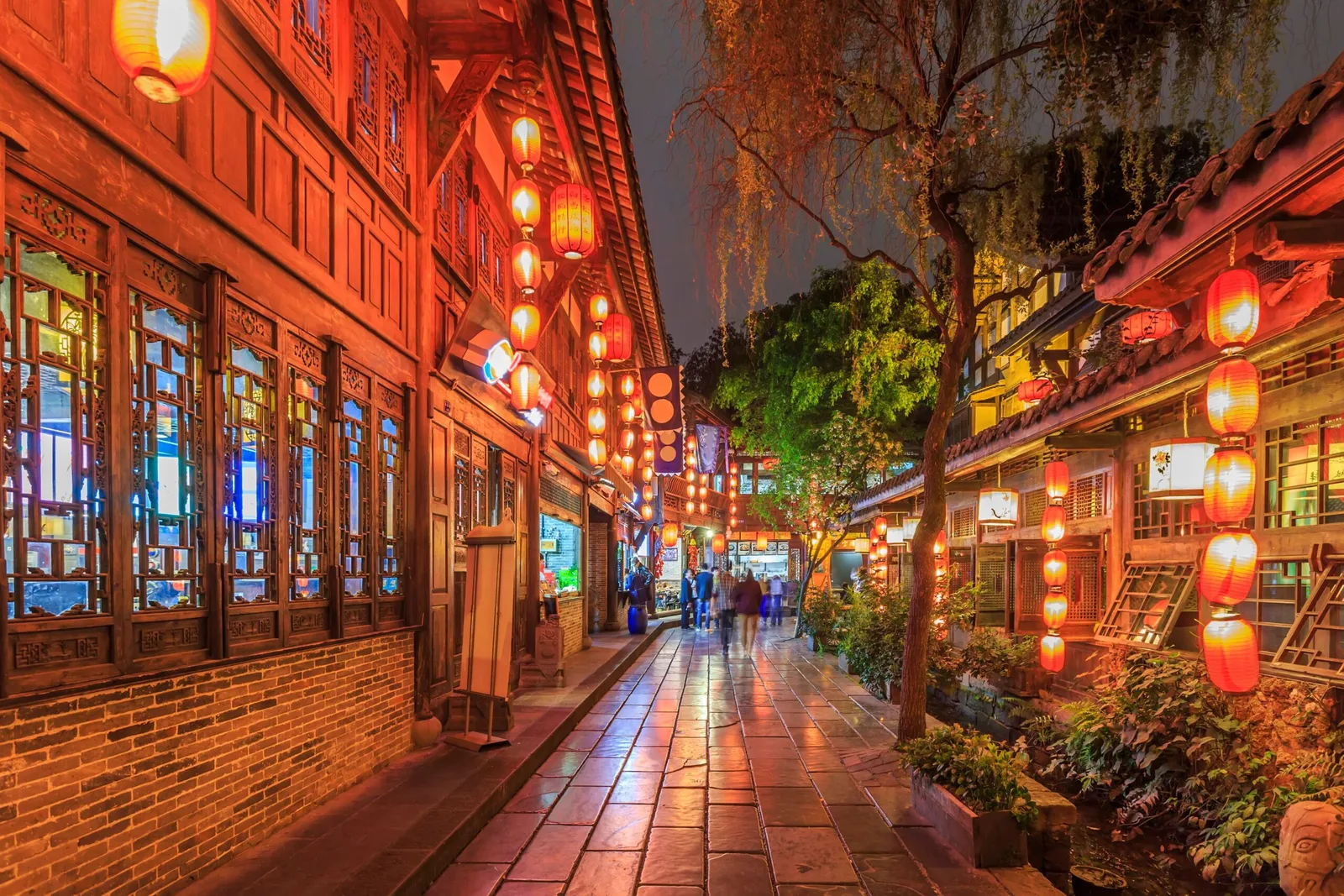
Many people arrive in Chengdu with giant pandas in mind. And rightly so, because watching these animals in their reserve is an experience that is hard to forget. But it would be a pity to stop there. Chengdu is one of the cities where the rhythm of Chinese life is most keenly felt. In the tea houses, frequented every day by residents of all ages, time seems to slow down. People meet to read the newspaper, play mahjong, discuss politics or simply watch the world go by. It is a very different picture from that of the ultra-high-tech metropolises we so often associate with China. And it is precisely this ability to change face from one region to the next that makes the country so fascinating.
Shanghai: when the future arrives ahead of schedule
The last stop on the journey seems to belong to another era. Strolling along the Bund, among colonial buildings reminiscent of early twentieth-century Europe, you need only raise your eyes to the far bank of the Huangpu river to see one of the most iconic skylines on the planet. The incredible thing is that until the early 1990s Pudong was largely occupied by farmland, warehouses and old shipyards. In little more than thirty years it has become the symbol of the new China. Perhaps no other city tells so well the extraordinary speed with which this country has changed.

'%3e%3cg id='Final-Copy-2_2_' transform='translate(1275.000000, 200.000000)'%3e%3cpath class='st0' d='M7.4,12.8h6.8l3.1-11.6H7.4C4.2,1.2,1.6,3.8,1.6,7S4.2,12.8,7.4,12.8z'/%3e%3c/g%3e%3c/g%3e%3c/g%3e%3cg id='final---dec.11-2020'%3e%3cg id='_x30_208-our-toggle' transform='translate(-1275.000000, -200.000000)'%3e%3cg id='Final-Copy-2' transform='translate(1275.000000, 200.000000)'%3e%3cpath class='st1' d='M22.6,0H7.4c-3.9,0-7,3.1-7,7s3.1,7,7,7h15.2c3.9,0,7-3.1,7-7S26.4,0,22.6,0z M1.6,7c0-3.2,2.6-5.8,5.8-5.8 h9.9l-3.1,11.6H7.4C4.2,12.8,1.6,10.2,1.6,7z'/%3e%3cpath id='x' class='st2' d='M24.6,4c0.2,0.2,0.2,0.6,0,0.8l0,0L22.5,7l2.2,2.2c0.2,0.2,0.2,0.6,0,0.8c-0.2,0.2-0.6,0.2-0.8,0 l0,0l-2.2-2.2L19.5,10c-0.2,0.2-0.6,0.2-0.8,0c-0.2-0.2-0.2-0.6,0-0.8l0,0L20.8,7l-2.2-2.2c-0.2-0.2-0.2-0.6,0-0.8 c0.2-0.2,0.6-0.2,0.8,0l0,0l2.2,2.2L23.8,4C24,3.8,24.4,3.8,24.6,4z'/%3e%3cpath id='y' class='st3' d='M12.7,4.1c0.2,0.2,0.3,0.6,0.1,0.8l0,0L8.6,9.8C8.5,9.9,8.4,10,8.3,10c-0.2,0.1-0.5,0.1-0.7-0.1l0,0 L5.4,7.7c-0.2-0.2-0.2-0.6,0-0.8c0.2-0.2,0.6-0.2,0.8,0l0,0L8,8.6l3.8-4.5C12,3.9,12.4,3.9,12.7,4.1z'/%3e%3c/g%3e%3c/g%3e%3c/g%3e%3c/g%3e%3c/svg%3e) Cookie preferences
Cookie preferences