

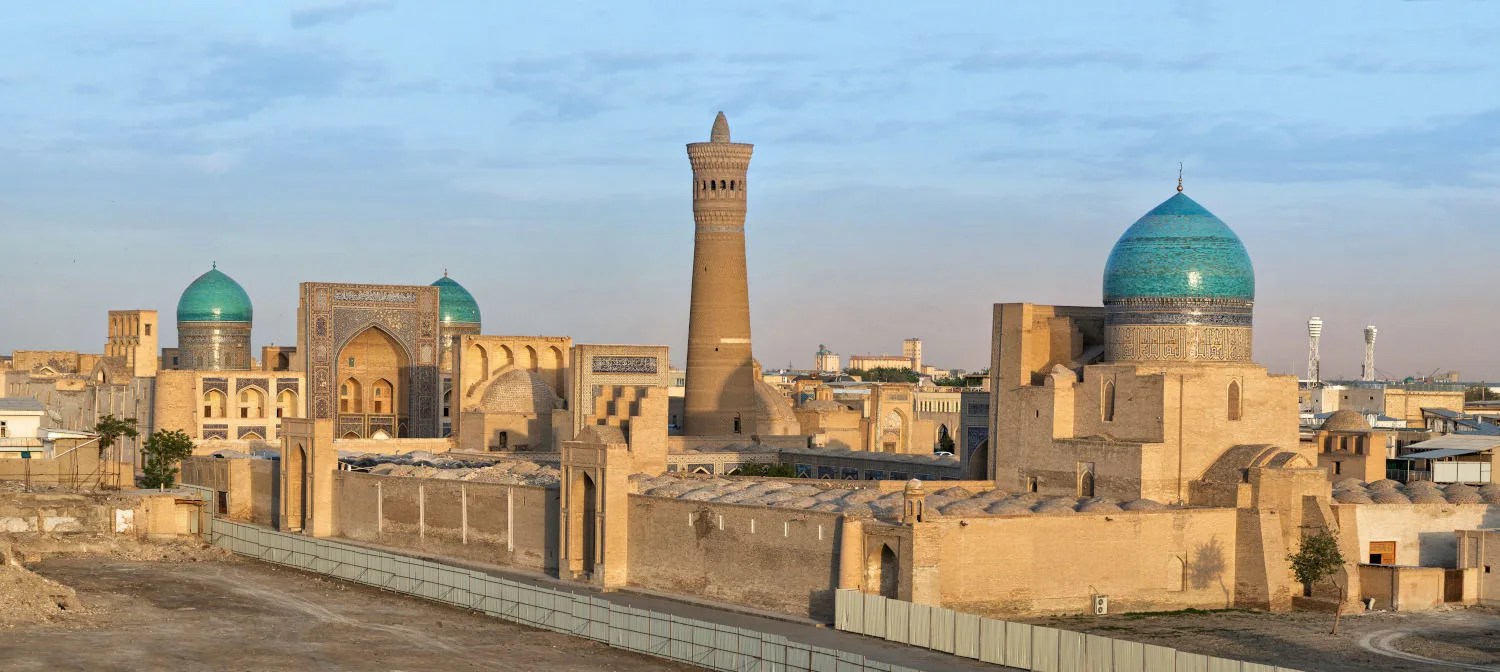
8000 km that in ancient times linked East and West to foster trade: the Silk Road is still today the object of historical and cultural interest. The routes along this path cross numerous countries and regions, bringing profoundly different cultures into contact with one another.
The very name Silk Road evokes the allure of the ancient East, a land of fabrics, spices and precious objects of every kind.
The cities that grew up along this route were for millennia crossroads of merchants, travellers, pilgrims, scholars and artists; Bukhara fits this category perfectly, being still considered today one of the wonders of the Silk Road.
The noble city
It is no coincidence that Bukhara is still called the “noble city”: time, in fact, seems to have stood still in a distant past when the city was crossed by merchant caravans; today it is home to a countless number of spectacular monuments, designated UNESCO World Heritage.
The old town, too, has preserved the mercantile spirit of the past: the workshops that follow one after another continue to sell local handicrafts, which visitors can buy, though not without the customary round of haggling.
Bukhara was the ancient capital of the Samanid kingdom and, though less celebrated than famous Samarkand, is still today a destination of the highest cultural calibre. No fewer than 140 monuments of historical, cultural and architectural interest are recognised by UNESCO.
Visitors are therefore advised to wear comfortable shoes to discover all the countless traces of the city’s ancient splendour; those setting out on a tour of the city are enchanted by the majesty of the celebrated Lyabi-Hauz square, the beating heart of the old town, where you can meet, relax and watch city life go by in the shade of centuries-old mulberry trees.
This central space has always been a place where people meet and mingle, and it is from here that numerous alleys branch off, full of markets and bazaars where you can shop. This area was once a constant bustle of merchants trading spices, hides, silk and precious objects, and even today you can still pick up a good bargain.
The buildings that originally housed the city bazaars were distinguished by a dome on top, whose function was to channel cool air downwards to ease the merchants’ bargaining below. Even today, in this area, you can admire these brightly coloured domes.
The tour continues to the square where the Ulugh Beg Madrasa and the Aziz Khan Madrasa face one another; thanks to the splendid decoration of their façades, the architectural space that houses them offers a spectacular sight.
In ancient times the madrasas were places of religion and study, where students could deepen their knowledge of mathematics and astronomy. The Ulugh Beg Madrasa is the oldest in all of Central Asia and was built by the Timurid ruler of the same name, grandson of Tamerlane. Completed in 1417, it bears witness to a period of great splendour and cultural ferment.
The building opposite dates instead from the 1600s and was built by the ruler Abdul Aziz Khan, who wished to surpass the magnificence of the building commissioned by Ulugh Beg; and indeed this madrasa too is richly decorated with coloured ceramics, glazed tiles and alabaster frescoes.
Equally unmissable is the Kalyan minaret, dating from the twelfth century and a full 47 metres high; in the past it was a landmark for merchants arriving by caravan from far away who, on sighting it, could find their bearings. Its exterior, too, is decorated with 14 bands of green and turquoise tiles, making it majestic and scenic.
The tower is part of a religious complex that also includes the Kalyan mosque, completed in the first half of the sixteenth century, whose outline is distinguished by no fewer than 288 domes.
The oldest and most important building in the whole city is the celebrated Ismail Samani Mausoleum, a testament to the Samanid period, built in the tenth century. Its cube-shaped architectural structure embraces various influences from the Islamic world, recalling the forms of Mecca. It is unusual in lacking the classic ceramic-tile decoration typical of the city’s other monuments: here the bricks of the structure seem to take on slightly different shades of colour depending on the light of day.
This is just a small taste of the architectural wonders to be visited in the city. Guiness tours to Uzbekistan will let you discover and fully appreciate the history, culture and artistic heritage of this fascinating country.
Choose Guiness Travel’s tours
With Guiness Travel you can set off to discover these places of rare beauty, visiting the many sites of great merit and coming into contact with local life.
All Guiness itineraries are 100% independently planned and carefully designed and tested, allowing our product to evolve constantly and to reach a high, wide-ranging cultural standard.
The Guiness Exclusive Tour is a unique travel experience, mindful of sustainability, that offers you considerable advantages:
- organisation;
- attention to detail;
- carefully selected services on the ground (designed to give you maximum comfort, leaving you free to think of nothing but enjoying the moment).
Discover our tours in Uzbekistan.
Discover our tours in Uzbekistan
Team Guiness

'%3e%3cg id='Final-Copy-2_2_' transform='translate(1275.000000, 200.000000)'%3e%3cpath class='st0' d='M7.4,12.8h6.8l3.1-11.6H7.4C4.2,1.2,1.6,3.8,1.6,7S4.2,12.8,7.4,12.8z'/%3e%3c/g%3e%3c/g%3e%3c/g%3e%3cg id='final---dec.11-2020'%3e%3cg id='_x30_208-our-toggle' transform='translate(-1275.000000, -200.000000)'%3e%3cg id='Final-Copy-2' transform='translate(1275.000000, 200.000000)'%3e%3cpath class='st1' d='M22.6,0H7.4c-3.9,0-7,3.1-7,7s3.1,7,7,7h15.2c3.9,0,7-3.1,7-7S26.4,0,22.6,0z M1.6,7c0-3.2,2.6-5.8,5.8-5.8 h9.9l-3.1,11.6H7.4C4.2,12.8,1.6,10.2,1.6,7z'/%3e%3cpath id='x' class='st2' d='M24.6,4c0.2,0.2,0.2,0.6,0,0.8l0,0L22.5,7l2.2,2.2c0.2,0.2,0.2,0.6,0,0.8c-0.2,0.2-0.6,0.2-0.8,0 l0,0l-2.2-2.2L19.5,10c-0.2,0.2-0.6,0.2-0.8,0c-0.2-0.2-0.2-0.6,0-0.8l0,0L20.8,7l-2.2-2.2c-0.2-0.2-0.2-0.6,0-0.8 c0.2-0.2,0.6-0.2,0.8,0l0,0l2.2,2.2L23.8,4C24,3.8,24.4,3.8,24.6,4z'/%3e%3cpath id='y' class='st3' d='M12.7,4.1c0.2,0.2,0.3,0.6,0.1,0.8l0,0L8.6,9.8C8.5,9.9,8.4,10,8.3,10c-0.2,0.1-0.5,0.1-0.7-0.1l0,0 L5.4,7.7c-0.2-0.2-0.2-0.6,0-0.8c0.2-0.2,0.6-0.2,0.8,0l0,0L8,8.6l3.8-4.5C12,3.9,12.4,3.9,12.7,4.1z'/%3e%3c/g%3e%3c/g%3e%3c/g%3e%3c/g%3e%3c/svg%3e) Cookie preferences
Cookie preferences