

Alberto Moravia and Pier Paolo Pasolini visited it in 1961 and were so captivated that, on their return, both wrote an account of their journey. But they are certainly not the only ones to have been struck by the contradictory charm so typical of India.
Travellers from all over the world have loved the wonders and peculiarities of this country, enchanted by the splendour of the Maharajas and the magnificence of one of the wonders of the modern world, the Taj Mahal.
A journey through Rajasthan cannot fail to touch your soul, offering culture, adventure, spirituality and moments of deep reflection.
One of the seven wonders of the modern world
Its outline and colours are famous the world over and make it the symbol of India par excellence; it is no coincidence that this splendid monument is one of the seven wonders of the modern world and, since 1983, a UNESCO World Heritage Site.
It is one of the must-see stops on any trip to India and is especially loved by honeymooners; according to tradition, in fact, the monument symbolises the eternal love of the seventeenth-century emperor Shah Jahan for his second wife Mumtaz Mahal, from whom it is said to take its name.
She lost her life giving birth to the emperor’s child during a military campaign, and the sovereign then decided to build a monument so magnificent, rich and sumptuous that it would perpetuate the memory of the deceased for ever.
The construction work lasted for years and involved craftsmen from all over the country: architects, calligraphers, mosaicists and marble workers shaped the most precious materials of the age to create a unique architectural work.
Unfortunately, a few years after its construction, the emperor Shah Jahan was imprisoned and the Taj Mahal was abandoned and stripped of its precious decorations; only at the start of the twentieth century, under British rule, was the monument restored.
Many legends surround the monument and local guides never fail to recount them to visitors, so as to bring out all the historical charm of the place; the best time to visit the Taj Mahal is at dawn or at sunset, to enjoy the play of light across the surfaces of the building.
The immense complex is made up of several elements: the darwaza (gateway), the bageecha (garden), the masjid (mosque), the mihman khana (“guest house”), the mausoleum, containing the tomb of the emperor Shah Jahan, and the four minarets, whose tops can be reached by an internal spiral staircase.
The garden is dotted with flowerbeds, flowers, tree-lined avenues and water channels that make the whole complex even more magnificent.
The state of Rajasthan
The state of Rajasthan is without doubt the most frequented and visited by tourists from all over the world, thanks to its high density of UNESCO World Heritage Sites, attractions to visit, bazaars, temples, cities and markets.
The possibilities are many and suit every taste; one particularly important piece of advice is to try to alternate visits to the cities, always very crowded, with a few stops in the countryside surrounding the urban centres, where life flows more slowly and you can “catch your breath”.
Udaipur, also known as the “Venice of India” or the “white city”, certainly deserves a visit; its palaces overlook the water, creating a highly evocative atmosphere. In the historic centre you can stroll at leisure, admiring the local beauties and the craft shops. The city is also home to the City Palace, the famous architectural complex built over the centuries by the Maharajas, overlooking Lake Pichola.
The state capital, Jaipur, is called the “pink city” because so many of the houses in the old town are of exactly this colour. Here too, as in the other Indian cities, there is no shortage of bazaars, markets and the classic din that accompanies travellers through the city streets. The historic palaces are sumptuous and architecturally fascinating; the Jaipur City Palace and the Astronomical Observatory are certainly worth a visit.
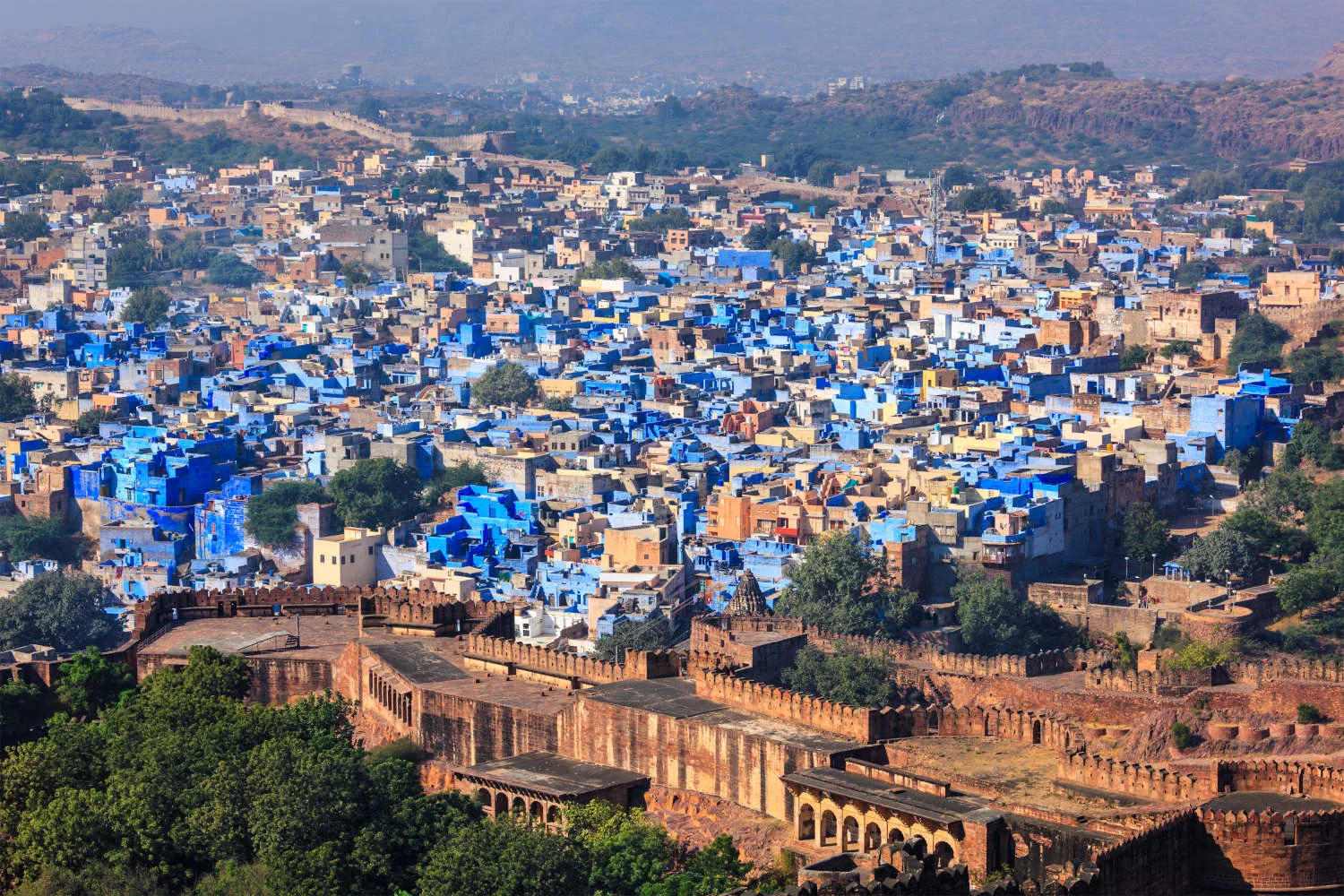
The classic itinerary through this area also takes in the city of Jodhpur, famous as the “blue city” for the colour of its houses. Here you can visit Mehrangarh Fort, which rises on the hill dominating the city, and the celebrated Umaid Bhawan Palace, partly the residence of the Maharaja of Jodhpur, with over three hundred luxurious rooms. Here too the alleys are lined with bazaars, markets selling spices, fruit and vegetables, and colourful fabrics that help create a very lively atmosphere.
Not to be missed is a visit to the oldest city in the state, Jaisalmer, which owes its fame to the yellow colour of its buildings, built in sandstone. In the centre, around the central market square, the sumptuous palaces of the merchants alternate with the bazaars selling local products. The Fort, a UNESCO World Heritage Site, is truly spectacular: it is still inhabited by the local population today and is made up of a maze of narrow streets alternating with imposing palaces.
Choose the Guiness Travel Tours
With Guiness Travel you can set off to discover this country of rare beauty, visiting its many prized sites and coming into contact with the frenetic local life.
All Guiness itineraries are 100% independently planned and carefully designed and tested, allowing the product to evolve constantly and reach a high, wide-ranging cultural standard.
The Guiness Exclusive Tour is a unique travel experience, mindful of sustainability, which will give you considerable advantages:
- organisation;
- attention to detail;
- the search for excellent services on site (designed to give you maximum comfort, leaving you free to think of nothing but enjoying the moment).
Team Guiness

'%3e%3cg id='Final-Copy-2_2_' transform='translate(1275.000000, 200.000000)'%3e%3cpath class='st0' d='M7.4,12.8h6.8l3.1-11.6H7.4C4.2,1.2,1.6,3.8,1.6,7S4.2,12.8,7.4,12.8z'/%3e%3c/g%3e%3c/g%3e%3c/g%3e%3cg id='final---dec.11-2020'%3e%3cg id='_x30_208-our-toggle' transform='translate(-1275.000000, -200.000000)'%3e%3cg id='Final-Copy-2' transform='translate(1275.000000, 200.000000)'%3e%3cpath class='st1' d='M22.6,0H7.4c-3.9,0-7,3.1-7,7s3.1,7,7,7h15.2c3.9,0,7-3.1,7-7S26.4,0,22.6,0z M1.6,7c0-3.2,2.6-5.8,5.8-5.8 h9.9l-3.1,11.6H7.4C4.2,12.8,1.6,10.2,1.6,7z'/%3e%3cpath id='x' class='st2' d='M24.6,4c0.2,0.2,0.2,0.6,0,0.8l0,0L22.5,7l2.2,2.2c0.2,0.2,0.2,0.6,0,0.8c-0.2,0.2-0.6,0.2-0.8,0 l0,0l-2.2-2.2L19.5,10c-0.2,0.2-0.6,0.2-0.8,0c-0.2-0.2-0.2-0.6,0-0.8l0,0L20.8,7l-2.2-2.2c-0.2-0.2-0.2-0.6,0-0.8 c0.2-0.2,0.6-0.2,0.8,0l0,0l2.2,2.2L23.8,4C24,3.8,24.4,3.8,24.6,4z'/%3e%3cpath id='y' class='st3' d='M12.7,4.1c0.2,0.2,0.3,0.6,0.1,0.8l0,0L8.6,9.8C8.5,9.9,8.4,10,8.3,10c-0.2,0.1-0.5,0.1-0.7-0.1l0,0 L5.4,7.7c-0.2-0.2-0.2-0.6,0-0.8c0.2-0.2,0.6-0.2,0.8,0l0,0L8,8.6l3.8-4.5C12,3.9,12.4,3.9,12.7,4.1z'/%3e%3c/g%3e%3c/g%3e%3c/g%3e%3c/g%3e%3c/svg%3e) Cookie preferences
Cookie preferences