

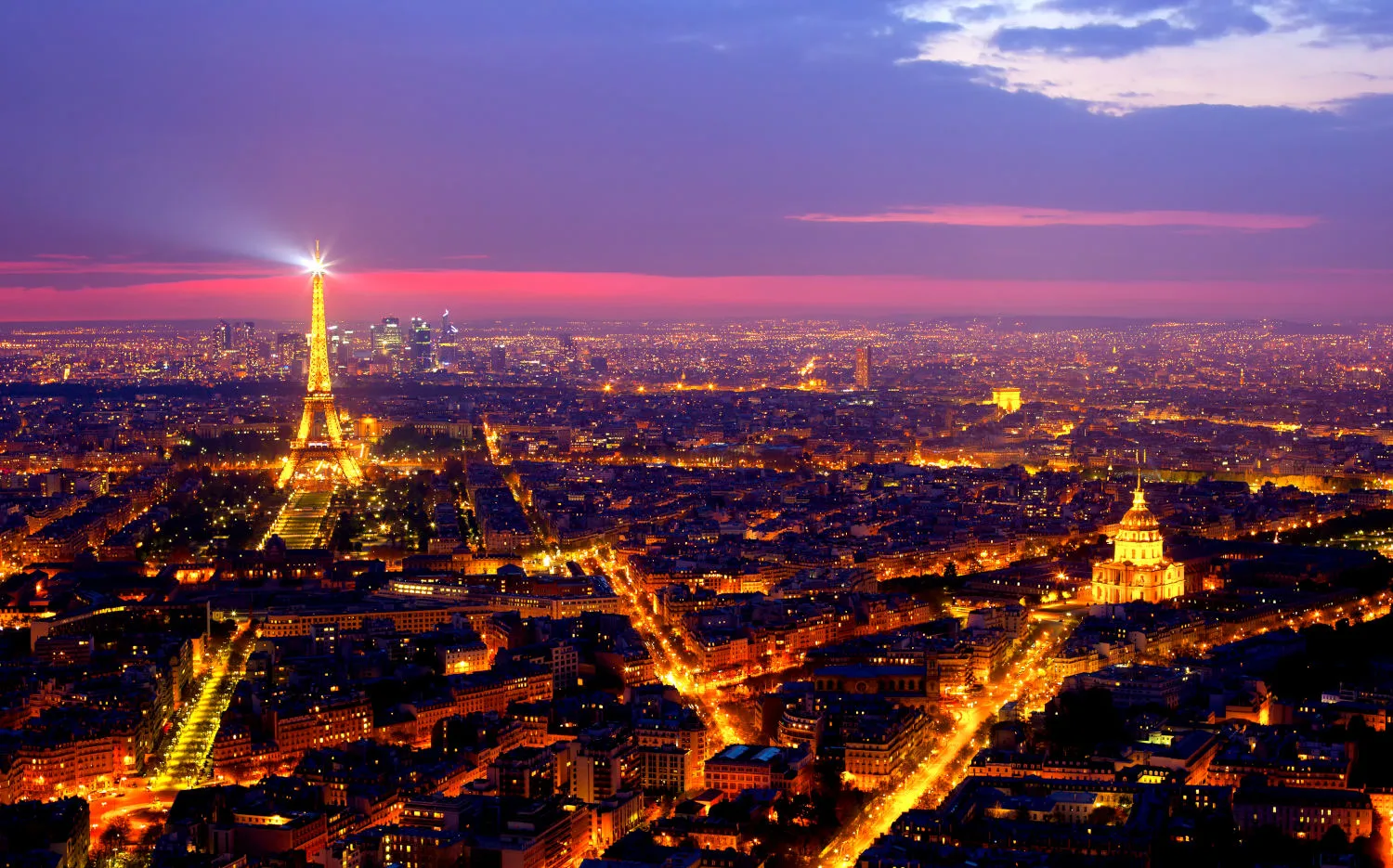
Paris est toujours une bonne idée (Paris is always a good idea): so said the famous Audrey Hepburn and, indeed, it is quite true.
Everyone knows the capital’s greatest monuments and iconic places: the soaring Eiffel Tower, the winding course of the Seine, the wide, elegant avenues studded with designer shops and boutiques, the Michelin-starred restaurants and the fragrant boulangeries.
Paris is the classic destination you can visit countless times without ever tiring of it, because there is always something to see and discover. Its charm is timeless, and it is no coincidence that over the centuries this city has drawn writers, poets, men of letters, critics and artists who made it the true protagonist of their masterpieces.
It has something to offer in every season, but it is in December, when the gardens of the Eiffel Tower turn white with the first snow and the Champs-Élysées light up with Christmas lights, that the “Ville Lumière” takes on a very special charm.
And it is precisely by taking you by the hand along a different itinerary, less well known but no less fascinating, that we want to convey all the enchantment of Paris, capable of satisfying even the most demanding traveller.
Les passages de Paris
The philosopher Walter Benjamin devoted a book to these covered arcades, most of which were built in the 1820s and 1830s; these are places where you can still stroll, sheltered from the cold and the rain, admiring the windows of antique shops, collectors’ dealers, old bookshops, small artisans and high fashion.
In the first half of the nineteenth century the urban layout of the city was profoundly altered by the intervention of Baron Haussmann, backed by Napoleon III; in this period several unhealthy, foul-smelling areas of the city were “cleaned up” and the Grands Boulevards we still walk along today were created. As part of this transformation the passages were also built, largely using metal structures and glass roofs.
Today, anyone wishing to discover these places still steeped in the charm of nineteenth-century Paris can head for the Rive Droite and, strolling between the 2nd and 9th arrondissements, pass through around twenty of them, enjoying the architectural spectacle.
A morning at the market
The Richard Lenoir market, also known as the Marché Bastille (being very close to Place de la Bastille), is an institution for Parisians wishing to buy food; the central strip of the Boulevard Richard Lenoir of the same name is “carpeted” with stalls selling all kinds of produce: cheeses, fruit and vegetables, fish, oysters, wines, meats, etc. All strictly made in France and of the highest quality.
To discover the most authentic Parisian habits it is a pleasure to lose yourself among the stalls, take advantage of the many tastings on offer and “fill up” on the scents and sounds of such a lively and characterful place.
It should be said that in Paris the neighbourhood markets are a real tradition and the best way to stock up on local produce: every arrondissement has one or more food markets that attract locals and tourists alike. Nor should we forget the colourful Marché aux fleurs et aux oiseaux, where from Monday to Saturday you can find flowers, plants and shrubs, while on Sundays it hosts the sale of birds. Very easy to find, as it is located in the heart of the Île de la Cité.
Le musée de l’Orangerie
Art lovers in Paris are spoilt for choice, and a month would not be enough to visit the city’s entire museum heritage; the offer is wide and there are several museums, slightly less well known than the most famous ones, that nonetheless hold works of art of immense value and beauty.
One of these is the musée de l’Orangerie, home to the enormous decorative cycle of the Nymphéas painted by Claude Monet, the father of Impressionism.
The building was actually constructed to shelter the orange trees of the Jardin des Tuileries during the winter, which is why it seems to have the appearance of a greenhouse; over the centuries it has been renovated several times and adapted to serve as a museum.
When Monet donated the enormous Impressionist canvases (two metres high and 91 metres long), two oval rooms were specially created, forming the symbol of infinity. Entering the rooms means living a true artistic experience that allows the visitor to come into deep contact with the meaning of the work.
Thanks to the donation of the Paul Guillaume and Domenica Walter collection, the museum offers a cross-section of twentieth-century art, displaying the works of the great Impressionists alongside the exponents of the main avant-garde movements of the 1900s. The exhibition route is indeed marked by a continuous dialogue between modernity and a return to tradition, offering the point of view of artists such as Renoir, Matisse, Cézanne, Picasso, Rousseau, Modigliani, etc.
A Sunday morning stroll through the Marais
The Marais is one of the most famous and best-loved districts of Paris: it is very busy, especially on Sundays, when cafés and shops are always open.
It was originally home to the Jewish quarter and a large community is still present today (especially around the rue des Rosiers area), which is why on Saturdays the cafés, restaurants and shops in the area of the old quarter are closed. By contrast, on Sundays the streets are full of life and people meet up for a coffee, a brunch or a browse around the shops.
In the streets of the old Jewish quarter you can sample specialities of Jewish cuisine in the area’s many restaurants, bakeries and delicatessens; moving away from rue des Rosiers, the Marais spreads out to host restaurants, nightspots and design and alternative fashion shops.
On Sunday mornings the Marais is the place to be: start with brunch in one of the many fashionable restaurants, carry on with a browse around the shops and arrive at Place des Vosges, the oldest square in Paris, for a coffee or a break on the benches in the garden. In the afternoon you can continue with a visit to the famous Picasso Museum, finally reopened a few years ago after a long restoration, and then leave the busiest streets behind to discover the quieter parts of the district, where houses alternate with almost hidden gardens and picturesque cafés.
A visit to the Opéra Garnier
The historic Opéra theatre was built by Charles Garnier, who designed a majestic and imposing building in an eclectic style. Today the theatre mainly hosts ballet and, as well as offering a high-quality programme, gives you the chance to visit its interior. When there are no rehearsals or performances under way you can also visit the auditorium and admire the painting by Marc Chagall that decorates the ceiling; the building also houses a museum with a collection of sets, costumes and stage machinery that tell the story of the place.
During the visit you can go up to the outdoor panoramic terrace and admire the view over the Parisian boulevards.
The theatre stands in a particularly elegant and refined area, so after the visit why not walk along the luxurious rue de la Paix, admiring the windows of the capital’s most important jewellers? You come to the famous Place Vendôme, home to the Hôtel Ritz and a number of haute couture boutiques.
After “feasting your eyes”, carry on to the Jardin des Tuileries, where you can rest on a bench, surrounded by greenery and, if you are lucky, kissed by the sun.
Guiness Travel offers several Tours to Paris that take in the most famous places and the less well-known ones, with the aim of letting travellers experience the magic that sets this wonderful city apart.
Choose the Guiness Travel Tours
For Guiness Travel, travelling is an enriching experience to be savoured in every respect: so food has its part to play too. In all our itineraries every last detail is taken care of, including the places where you eat.
All the itineraries in the catalogue are 100% independently planned and carefully designed and tested, allowing the product to evolve constantly and reach a high, wide-ranging cultural standard.
That is why we created the Guiness Exclusive Tour, a unique travel experience, mindful of sustainability, which will give you considerable advantages:
- organisation;
- attention to detail;
- the search for excellent services on site (designed to give you maximum comfort, leaving you free to think of nothing but enjoying the moment).
DISCOVER ALL OF GUINESS TRAVEL’S PROPOSALS FOR PARIS
Team Guiness

'%3e%3cg id='Final-Copy-2_2_' transform='translate(1275.000000, 200.000000)'%3e%3cpath class='st0' d='M7.4,12.8h6.8l3.1-11.6H7.4C4.2,1.2,1.6,3.8,1.6,7S4.2,12.8,7.4,12.8z'/%3e%3c/g%3e%3c/g%3e%3c/g%3e%3cg id='final---dec.11-2020'%3e%3cg id='_x30_208-our-toggle' transform='translate(-1275.000000, -200.000000)'%3e%3cg id='Final-Copy-2' transform='translate(1275.000000, 200.000000)'%3e%3cpath class='st1' d='M22.6,0H7.4c-3.9,0-7,3.1-7,7s3.1,7,7,7h15.2c3.9,0,7-3.1,7-7S26.4,0,22.6,0z M1.6,7c0-3.2,2.6-5.8,5.8-5.8 h9.9l-3.1,11.6H7.4C4.2,12.8,1.6,10.2,1.6,7z'/%3e%3cpath id='x' class='st2' d='M24.6,4c0.2,0.2,0.2,0.6,0,0.8l0,0L22.5,7l2.2,2.2c0.2,0.2,0.2,0.6,0,0.8c-0.2,0.2-0.6,0.2-0.8,0 l0,0l-2.2-2.2L19.5,10c-0.2,0.2-0.6,0.2-0.8,0c-0.2-0.2-0.2-0.6,0-0.8l0,0L20.8,7l-2.2-2.2c-0.2-0.2-0.2-0.6,0-0.8 c0.2-0.2,0.6-0.2,0.8,0l0,0l2.2,2.2L23.8,4C24,3.8,24.4,3.8,24.6,4z'/%3e%3cpath id='y' class='st3' d='M12.7,4.1c0.2,0.2,0.3,0.6,0.1,0.8l0,0L8.6,9.8C8.5,9.9,8.4,10,8.3,10c-0.2,0.1-0.5,0.1-0.7-0.1l0,0 L5.4,7.7c-0.2-0.2-0.2-0.6,0-0.8c0.2-0.2,0.6-0.2,0.8,0l0,0L8,8.6l3.8-4.5C12,3.9,12.4,3.9,12.7,4.1z'/%3e%3c/g%3e%3c/g%3e%3c/g%3e%3c/g%3e%3c/svg%3e) Cookie preferences
Cookie preferences