

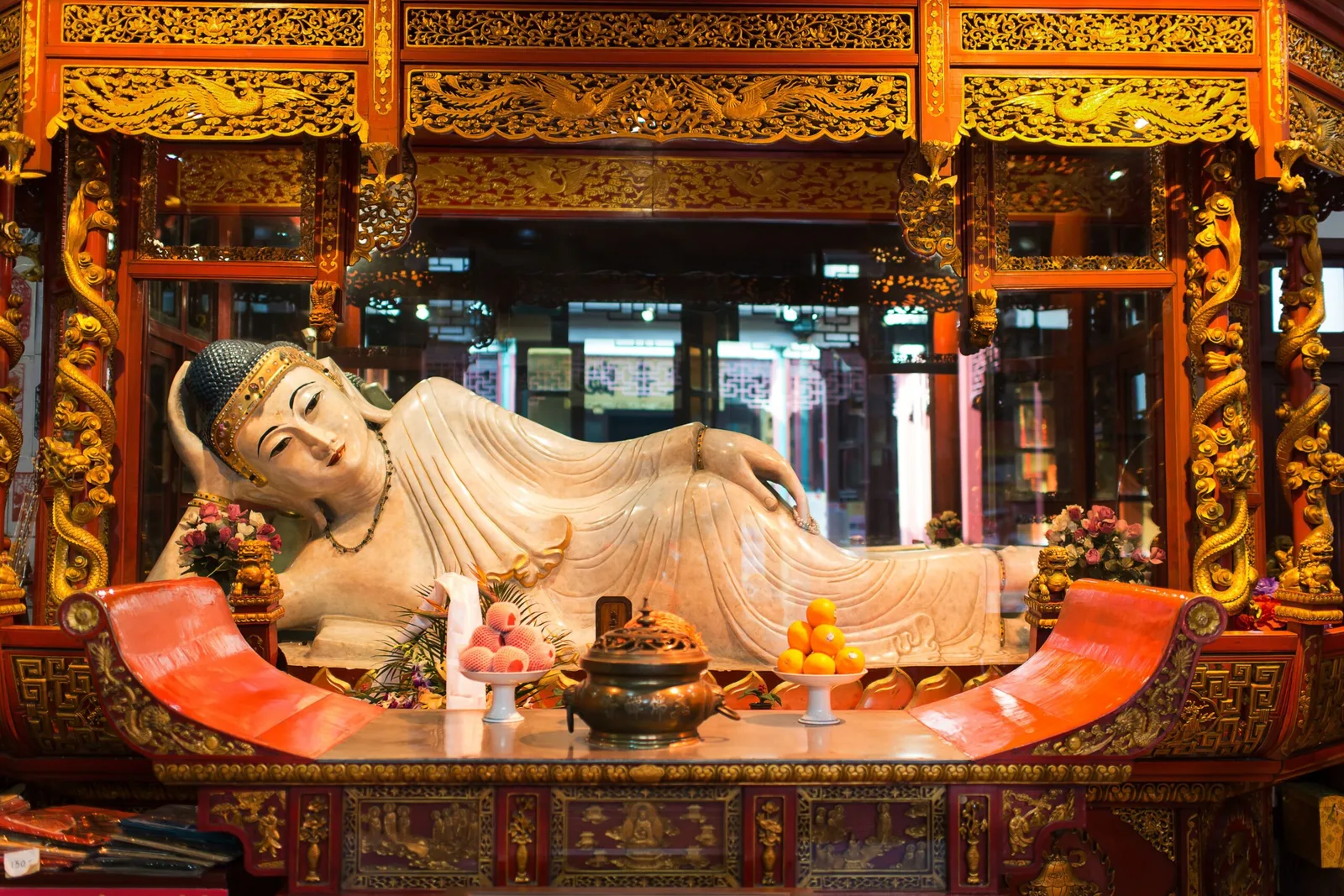
From the Emperors to the Roof of the World: the journey that unites China and mystical Tibet
Some itineraries merely show you a country; then there are journeys that connect seemingly distant worlds beneath a single, extraordinary sky. When we think of East Asia, the imagination divides: on one side the imperial dynasties of the land of the dragon, on the other the spiritual silence of the highest mountains on earth.
The China & Tibet itinerary by Guiness Travel performs a small miracle of travel: it unites the monumental grandeur of Beijing and Xi’an with the high-altitude spirituality of Lhasa, the capital of Tibet, before plunging into the vertical hyper-futurism of Shanghai. A linear, flowing route, designed for lovers of grand narratives, where history written in stone meets the land of the gods.
Beijing and the strategic corridors of the Celestial Empire
Our journey sets out from Beijing, a capital that reveals itself in layers, like a Chinese box full of secrets. The first true immersion in history takes place on the outskirts of the metropolis, along the Sacred Way leading to the Ming Tombs. Walking beneath the stone gaze of the colossal statues of guardians and mythological animals that watch over the route brings home the absolute devotion and respect that Chinese sovereigns felt towards the afterlife.
But it is before the Great Wall that the perception of time changes. For this route we have selected the legendary Juyongguan section, one of the most strategically important stretches of the entire work. Set in a narrow natural corridor that was the only true gateway to the capital from the north, this outpost was fortified to an almost unbelievable degree. Its towers were not merely lookout points but nodes in a cutting-edge communication network: smoke by day, fire by night, able to relay alarm signals at the speed of light, centuries before the invention of the telegraph.
In the heart of the city, the Forbidden City continues the tale of absolute power through the geometry of its architecture. With its 720,000 square metres and more than 9,000 rooms, the imperial palace is a hymn to numerology: nine, the emperor’s number, dominates every detail, from the studs on the gates to the decorations on the roofs, stopping symbolically one step short of ten thousand, the number reserved exclusively for the perfection of Heaven. Guiness’s Beijing, however, also finds expression in everyday life: from the incense-scented silence of the Lama Temple and the geometry of the Summer Palace, in the evening you find yourself strolling among the lanterns of Qianmen Street and the historic Dazhalan quarter, after honouring the table with traditional Peking duck.
Xi’an: the clay army and the spice road
Boarding the high-speed train, China flows past the window, revealing its transition westwards. We arrive in Xi’an, the city where Marco Polo lived for many years and the terminus of the Silk Road. The bond between this metropolis and international trade is evident as soon as you enter the Muslim Quarter. In the evening, with the Guiness tour leader, you plunge into a veritable Asian souk lit by neon signs, where the aromas of cumin and grilled meat mingle with those of the typical dinner of Chinese dumplings.
The following day is devoted to the greatest thrill of all: the encounter with the Terracotta Army. This immense silent host, standing guard over the Mausoleum of the first emperor Qin Shi Huang, holds a fascinating anecdote: archaeologists continue to excavate with extreme caution because the coloured pigments covering the warriors, intact for over two thousand years underground, risk fading within a few minutes on contact with modern air. An incredible fragility that contrasts with the mighty grandeur of the Ming-era city walls – among the best preserved in the world – and the verticality of the Giant Wild Goose Pagoda, before discovering the secrets of jade carving, the stone of the immortals.
Lhasa: on the Roof of the World, where time slows down
A scheduled flight carries us to where the air grows thinner and the sky an almost unreal cobalt blue: Lhasa, the capital of Tibet, the “land of the gods”. Standing before the Potala Palace, which dominates the valley from the top of the red hill, is an experience that touches deep chords and one of the most intense you can have on an escorted tour of China. This monumental fortress, for centuries the centre of the spiritual and temporal power of the Dalai Lamas, impresses with its white and crimson walls that seem to rise straight out of the rock.
Not far away, the Jokhang Temple is the most sacred heart of Tibetan Buddhism. Outside, along Barkhor Street, you witness the age-old rite of the kora: pilgrims from every corner of Tibet walk the sacred circuit around the temple clockwise, spinning prayer wheels and whispering mantras.
The days in Lhasa are a continuous journey into the spirituality and deep history of this people. We visit the great monasteries of Drepung and Sera; at the latter, if we are lucky, we may witness the famous debating sessions of the monks, who discuss Buddhist philosophy in the courtyard, emphasising their arguments with ritual hand gestures and claps of the palms. Finally, the Norbulingka, the former summer residence of the Dalai Lama with its gardens, offers an oasis of peace and reflection before we bid farewell to the high peaks.
Shanghai: back to the future
With a flight via Chengdu, the itinerary makes a leap forward in time, landing in Shanghai, the metropolis of tomorrow. The contrast with Tibetan mysticism is total and dizzying. Shanghai welcomes travellers with its tireless energy and its twin soul.
On one side, the orderly stillness of the Old City and the Yu Garden, where zigzag bridges (designed, according to tradition, to confuse evil spirits, which can only move in straight lines) lead to traditional tea houses. On the other, the Bund, the elegant colonial boulevard mirrored in the Huangpu river.
Raising your eyes from the Bund to the opposite bank, you admire the Pudong district: an expanse of skyscrapers that until the 1990s was nothing but farmland and that today is home to the iconic Television Tower. An evening stroll along the glittering Nanjing Road or among the fashionable venues of Xintiandi closes a perfect circle, suspended between the past of the great emperors and the vertical lights of tomorrow.
The value of organisation by Guiness Travel
Tackling a journey that combines the logistical complexity of inland China with the altitudes and special permits of Tibet calls for impeccable planning. Guiness Travel takes care of every detail, from the choice of Emirates scheduled flights to high-speed train transfers and the selection of the best local guides.
The constant presence of the Guiness tour leader for the entire duration of the itinerary ensures complete peace of mind at every moment of the journey, from airport formalities to evening strolls through the illuminated metropolises. A great journey, protected, comfortable and extraordinarily rich in emotion: the road to the Roof of the World is open.

'%3e%3cg id='Final-Copy-2_2_' transform='translate(1275.000000, 200.000000)'%3e%3cpath class='st0' d='M7.4,12.8h6.8l3.1-11.6H7.4C4.2,1.2,1.6,3.8,1.6,7S4.2,12.8,7.4,12.8z'/%3e%3c/g%3e%3c/g%3e%3c/g%3e%3cg id='final---dec.11-2020'%3e%3cg id='_x30_208-our-toggle' transform='translate(-1275.000000, -200.000000)'%3e%3cg id='Final-Copy-2' transform='translate(1275.000000, 200.000000)'%3e%3cpath class='st1' d='M22.6,0H7.4c-3.9,0-7,3.1-7,7s3.1,7,7,7h15.2c3.9,0,7-3.1,7-7S26.4,0,22.6,0z M1.6,7c0-3.2,2.6-5.8,5.8-5.8 h9.9l-3.1,11.6H7.4C4.2,12.8,1.6,10.2,1.6,7z'/%3e%3cpath id='x' class='st2' d='M24.6,4c0.2,0.2,0.2,0.6,0,0.8l0,0L22.5,7l2.2,2.2c0.2,0.2,0.2,0.6,0,0.8c-0.2,0.2-0.6,0.2-0.8,0 l0,0l-2.2-2.2L19.5,10c-0.2,0.2-0.6,0.2-0.8,0c-0.2-0.2-0.2-0.6,0-0.8l0,0L20.8,7l-2.2-2.2c-0.2-0.2-0.2-0.6,0-0.8 c0.2-0.2,0.6-0.2,0.8,0l0,0l2.2,2.2L23.8,4C24,3.8,24.4,3.8,24.6,4z'/%3e%3cpath id='y' class='st3' d='M12.7,4.1c0.2,0.2,0.3,0.6,0.1,0.8l0,0L8.6,9.8C8.5,9.9,8.4,10,8.3,10c-0.2,0.1-0.5,0.1-0.7-0.1l0,0 L5.4,7.7c-0.2-0.2-0.2-0.6,0-0.8c0.2-0.2,0.6-0.2,0.8,0l0,0L8,8.6l3.8-4.5C12,3.9,12.4,3.9,12.7,4.1z'/%3e%3c/g%3e%3c/g%3e%3c/g%3e%3c/g%3e%3c/svg%3e) Cookie preferences
Cookie preferences