

Northern India: secret geometries, sacred wells and the immortality of marble
Northern India, and in particular the Golden Triangle linking Delhi, Rajasthan and Agra, is often described as a sensory assault of colours and scents. Yet behind the veil of apparent chaos lies a country governed by an age-old harmony, where mathematics, astronomy and devotion merge into a single design.
This itinerary is built precisely as a key to deciphering the deepest, most geometric soul of India. A linear, mirror-like route leading the traveller from the dusty plains to the marble palaces, revealing how every stone, every street and every dome was conceived to reflect a higher order.
The vibrations of Delhi
The India Golden Triangle journey begins in Delhi, a metropolis that holds within it seven historic cities layered one upon another. Old Delhi reveals itself at once in the narrow lanes surrounding the Jama Masjid, the Friday Mosque, where the best way to get around is by rickshaw: a close-up vantage point that lets you slip into the beating heart of traditional commerce before finding solemn calm again at Raj Ghat, the site of Mahatma Gandhi’s cremation.
At the foot of the Qutab Minar, the tallest brick minaret in the world, you read the history of the first Islamic dynasties, a story enriched at Humayun’s Tomb. This monument, entirely in red sandstone and white marble, is India’s first “garden tomb”. Here the space is divided according to the chaharbagh model, a perfect quadrilateral symbolising the four rivers of the Quranic paradise, which would serve as the geometric prototype for the masterpieces to come.
The capital’s mysticism, however, expresses itself in unexpected forms: in the majestic Sikh complex of Gurudwara Bangla Sahib, spirituality is experienced walking barefoot among white marble and ritual chants; in the Lotus Temple, the Bahá’í faith is translated into contemporary architecture. This structure, which faithfully reproduces a lotus bud with twenty-seven petals of white marble, welcomes the faithful of every religion in an absolute and truly moving silence.
Jaipur, the charm of the Pink City
Moving on into Rajasthan, the landscape changes and turns pink. Jaipur is a one-off in urban planning: founded in the eighteenth century by Maharaja Jai Singh II, it did not grow spontaneously like other medieval cities but was designed on the drawing board according to a visionary chessboard grid. The districts were strictly divided according to the artisans’ trades, the main streets were a full thirty metres wide and the palaces were painted pink – the colour that symbolises welcome – to greet the visit of the British royal family in the nineteenth century.
Climbing the Aravalli Hills by jeep, you reach Amber Fort, a golden fortress commanding the road to Delhi. Behind its mighty walls lie royal apartments adorned with mirror mosaics, latticed windows and courtyards that bear witness to the wealth of the Maharajas.
Next to the Hawa Mahal, the famous Palace of the Winds whose latticed façade allowed the ladies of the court to watch the market without being seen, stands the Jantar Mantar. This extraordinary open-air astronomical observatory houses stone instruments of monumental size. Built in the eighteenth century, they served the scientist Maharaja to calculate local time to within a few seconds, draw up precise horoscopes and measure the position of the stars, uniting stone with celestial calculation.
Towards Agra
The first stop is Abhaneri, home to one of the largest stepwells on the planet. This structure was no mere reservoir but a masterpiece of inverted hydraulic engineering: an upside-down pyramid formed by thousands of symmetrical steps that made it possible to reach the water at whatever level it lay, offering the population a cool refuge during the scorching summers of Rajasthan.
A little further on, the plain is home to Fatehpur Sikri, known as “the ghost city”. Built in the sixteenth century by Emperor Akbar as the new capital of the Mughal Empire, it was abandoned after only a few years for lack of water. Today you walk through a labyrinth of perfectly intact palaces, mosques and courtyards, where the sandstone seems to await the return of a court that left it centuries ago, testament to the genius of a ruler who sought to fuse India’s different religious souls into a single architecture.
The ecstasy of marble on the banks of the Yamuna
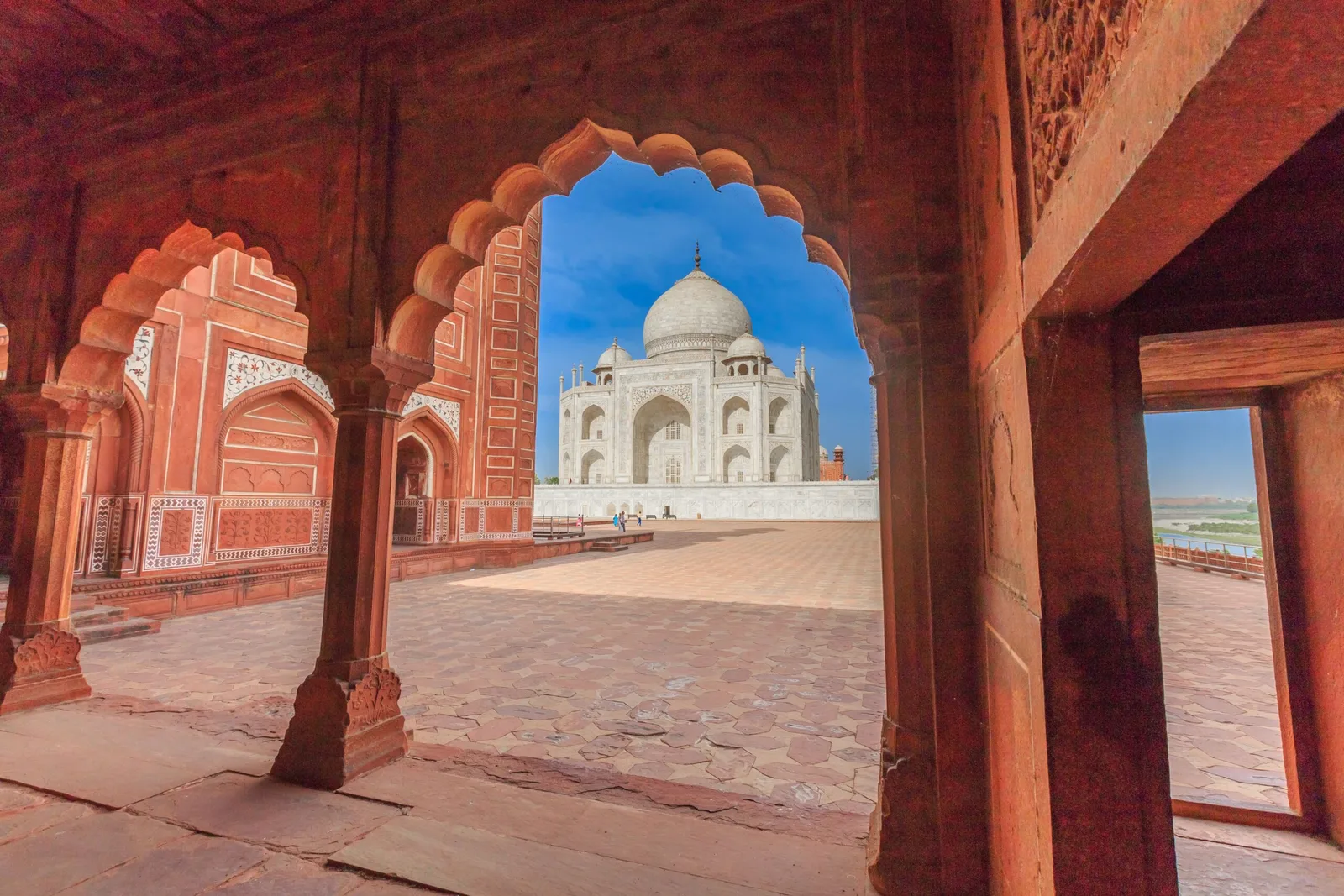
In Agra comes the definitive encounter with absolute symmetry, one of the high points of an escorted journey to India. The Taj Mahal, built in the seventeenth century by Emperor Shah Jahan, is the monument that more than any other embodies the meeting point between Earth and Heaven. Built entirely of white marble inlaid with hard and semi-precious stones from every corner of Asia, the mausoleum was born of a vow of eternal love for his wife Mumtaz Mahal.
Every element of the Taj Mahal is perfectly mirrored: the four minarets framing the great dome lean slightly outwards, an engineering device invisible to the eye but designed to make them fall away from the central body in the event of an earthquake. Reflected in the water channels of the geometric gardens, the marble changes colour with the light of day, passing from the pink of dawn to the pure white of the afternoon and on to the golden hues of sunset.
The journey through the Mughal dynasty ends a short distance away, within the walls of Agra Fort. This imposing red sandstone fortress, overlooking the sacred Yamuna river, was the official residence of the emperors. Walking among its white marble pavilions you breathe the opulence of the court, but you also meet the most dramatic part of the story: it was here, in a tower with a view of the Taj Mahal, that Emperor Shah Jahan spent the last years of his life, imprisoned by his son, able only to gaze from afar at the monument he had raised for his beloved.
The signature of a perfect journey
An itinerary crossing three states, combining the logistical complexity of Indian roads with the density of UNESCO World Heritage sites, demands absolute attention to detail. Choosing Guiness Travel means flying with excellent scheduled connections, travelling in private air-conditioned vehicles and enjoying carefully selected accommodation to guarantee the utmost comfort and relaxation, starting with early check-in on arrival in Delhi.
The added value is the constant presence of the Guiness tour leader, a key figure in decoding local customs, guiding you on the evening panoramic tours and turning a journey of discovery into a smooth, cultured and memorable travel experience.

'%3e%3cg id='Final-Copy-2_2_' transform='translate(1275.000000, 200.000000)'%3e%3cpath class='st0' d='M7.4,12.8h6.8l3.1-11.6H7.4C4.2,1.2,1.6,3.8,1.6,7S4.2,12.8,7.4,12.8z'/%3e%3c/g%3e%3c/g%3e%3c/g%3e%3cg id='final---dec.11-2020'%3e%3cg id='_x30_208-our-toggle' transform='translate(-1275.000000, -200.000000)'%3e%3cg id='Final-Copy-2' transform='translate(1275.000000, 200.000000)'%3e%3cpath class='st1' d='M22.6,0H7.4c-3.9,0-7,3.1-7,7s3.1,7,7,7h15.2c3.9,0,7-3.1,7-7S26.4,0,22.6,0z M1.6,7c0-3.2,2.6-5.8,5.8-5.8 h9.9l-3.1,11.6H7.4C4.2,12.8,1.6,10.2,1.6,7z'/%3e%3cpath id='x' class='st2' d='M24.6,4c0.2,0.2,0.2,0.6,0,0.8l0,0L22.5,7l2.2,2.2c0.2,0.2,0.2,0.6,0,0.8c-0.2,0.2-0.6,0.2-0.8,0 l0,0l-2.2-2.2L19.5,10c-0.2,0.2-0.6,0.2-0.8,0c-0.2-0.2-0.2-0.6,0-0.8l0,0L20.8,7l-2.2-2.2c-0.2-0.2-0.2-0.6,0-0.8 c0.2-0.2,0.6-0.2,0.8,0l0,0l2.2,2.2L23.8,4C24,3.8,24.4,3.8,24.6,4z'/%3e%3cpath id='y' class='st3' d='M12.7,4.1c0.2,0.2,0.3,0.6,0.1,0.8l0,0L8.6,9.8C8.5,9.9,8.4,10,8.3,10c-0.2,0.1-0.5,0.1-0.7-0.1l0,0 L5.4,7.7c-0.2-0.2-0.2-0.6,0-0.8c0.2-0.2,0.6-0.2,0.8,0l0,0L8,8.6l3.8-4.5C12,3.9,12.4,3.9,12.7,4.1z'/%3e%3c/g%3e%3c/g%3e%3c/g%3e%3c/g%3e%3c/svg%3e) Cookie preferences
Cookie preferences