

If you are looking for a place steeped in history yet at the same time modern and cosmopolitan, Thessaloniki is the destination for you.
This city gives you the chance to relax with a stroll along the waterfront as the sun goes down, admiring the sunsets over the Aegean Sea, to discover the wonders of Byzantine art and to enjoy the splendid beaches nearby.
Thessaloniki (also known as Salonica) is a city in northern Greece and the country’s second-largest city (after Athens); until 1912 Thessaloniki was one of the most important cities of the Ottoman Empire, whose traces can still be seen in its architecture and hammams.
The waterfront is much loved by locals and tourists alike, who gather there both by day and in the evening to enjoy the sunset together.
The centre is small and well worth exploring on foot, losing yourself in the city’s alleyways and perhaps stumbling upon a traditional restaurant where you can sample local specialities such as bougatsa and bouyiourdi.
A jewel of a city, a UNESCO World Heritage Site
The city can be considered an open-air Byzantine museum: indeed, all of the city’s monuments from the Byzantine, Early Christian and Ottoman periods have been declared artistic heritage by the State and, since 1988, have been inscribed on UNESCO’s World Heritage List.
Every district of Thessaloniki has preserved at least one monument from the Byzantine period, which strongly characterises the city’s urban and architectural fabric.
Although a number of traces of earlier and later eras of its past survive, such as those linked to the Ottoman period or to the Jewish community, it is the heritage of the Early Christian and Byzantine period that takes on fundamental importance from a historical and artistic point of view.
The fifteen monuments in the city inscribed on the UNESCO World Heritage List, built between the 4th and 15th centuries, are a well-preserved example of Byzantine art and architecture, revealing the multiplicity of trends and styles that developed over the centuries.
The religious buildings allow us to observe the evolution of Byzantine architecture, which moves from the three- or five-aisled plan of the Early Christian basilicas to the domed basilica (such as Agia Sofia), arriving at the cross-in-square churches with peristyle of the late Byzantine period (such as Agios Panteleimonas). Mosaic art, too, finds numerous developments and examples of considerable interest here.
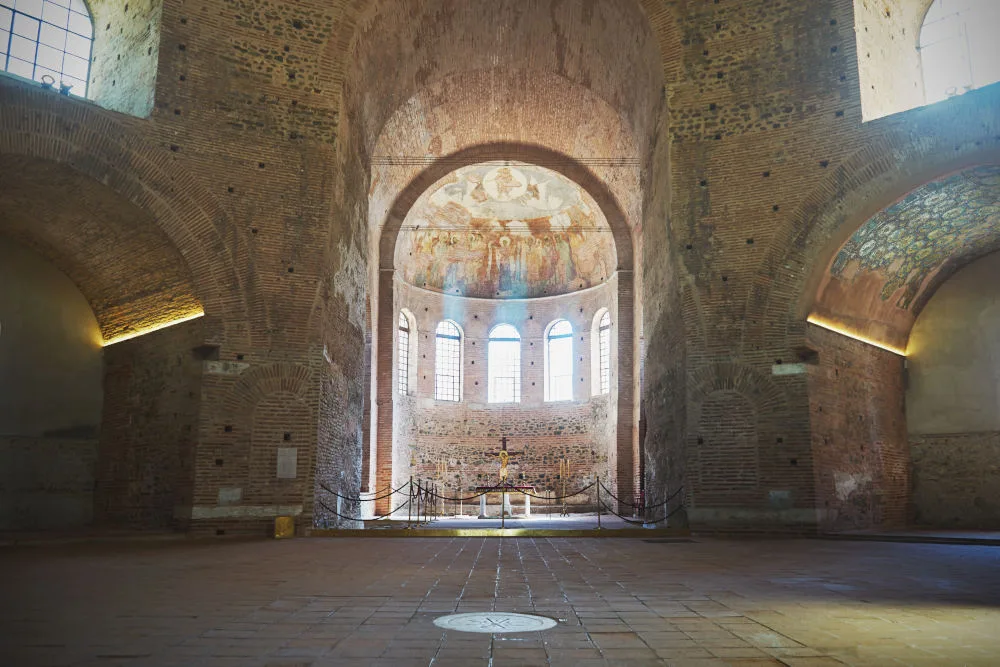
One of the city’s most celebrated monuments is the famous Rotunda, a circular building erected around 306, originally perhaps as a temple dedicated to the Emperor Galerius (to whom the celebrated Arch is also dedicated) and later converted into a church, a very common practice at the time. Inside, it preserves splendid mosaic cycles from the Early Christian era.
No tour of the monuments would be complete without a visit to the church of “Panagia Acheiropoietos”, a three-aisled basilica with narthex and gallery dating from the 5th century. Inside you can see the splendid capitals adorning the columns of the aisles, the fruit of the mastery achieved by the city’s workshops.
Further evidence of the high level reached by local craftsmen is the basilica of Agios Dimitrios, dedicated to the city’s patron saint. The interior, with its five aisles, transept and crypt, is enriched by beautiful decoration in which marble alternates with mosaic. The splendour of the mosaic cycles and the use of gold make the observer lose all perception of the architectural space.
The celebrated Agia Sofia dates from a later period and bears witness to the evolution of Byzantine architecture, with its Greek-cross plan crowned by a dome. The interior features rich mosaic decoration from several historical periods; the dome is decorated with a mosaic depicting the Ascension of Jesus, supported by two angels and surrounded by Mary and the twelve Apostles.
This is no more than a brief overview of the artistic and architectural wealth of Thessaloniki, which deserves a visit of a few days to admire the remains of its ancient past.
Choose the Guiness Travel Tours
The itinerary of the Guiness Grand Tour of Classical Greece naturally includes a stop in Thessaloniki to admire the monuments on the UNESCO World Heritage List.
For Guiness, travel is an enriching experience to be savoured in every pleasant moment, and it means being pampered with every kind of comfort; the only way to guarantee the well-being of participants and respect for the places visited is to open our tours only to a limited number of selected participants.
All the itineraries in the catalogue are 100% independently planned and are carefully designed and tested, allowing our product to evolve constantly and reach a high and wide-ranging cultural standard.
That is why we created the Guiness Exclusive Tour, a unique travel experience with an eye to sustainability, which gives you significant advantages:
- organisation;
- attention to detail;
- a search for excellent services on the ground (designed to give you maximum comfort, leaving you free to think of nothing but enjoying the moment).
Discover the Grand Tour of Classical Greece!
Discover the Guiness Travel Grand Tour of Classical Greece
Team Guiness


'%3e%3cg id='Final-Copy-2_2_' transform='translate(1275.000000, 200.000000)'%3e%3cpath class='st0' d='M7.4,12.8h6.8l3.1-11.6H7.4C4.2,1.2,1.6,3.8,1.6,7S4.2,12.8,7.4,12.8z'/%3e%3c/g%3e%3c/g%3e%3c/g%3e%3cg id='final---dec.11-2020'%3e%3cg id='_x30_208-our-toggle' transform='translate(-1275.000000, -200.000000)'%3e%3cg id='Final-Copy-2' transform='translate(1275.000000, 200.000000)'%3e%3cpath class='st1' d='M22.6,0H7.4c-3.9,0-7,3.1-7,7s3.1,7,7,7h15.2c3.9,0,7-3.1,7-7S26.4,0,22.6,0z M1.6,7c0-3.2,2.6-5.8,5.8-5.8 h9.9l-3.1,11.6H7.4C4.2,12.8,1.6,10.2,1.6,7z'/%3e%3cpath id='x' class='st2' d='M24.6,4c0.2,0.2,0.2,0.6,0,0.8l0,0L22.5,7l2.2,2.2c0.2,0.2,0.2,0.6,0,0.8c-0.2,0.2-0.6,0.2-0.8,0 l0,0l-2.2-2.2L19.5,10c-0.2,0.2-0.6,0.2-0.8,0c-0.2-0.2-0.2-0.6,0-0.8l0,0L20.8,7l-2.2-2.2c-0.2-0.2-0.2-0.6,0-0.8 c0.2-0.2,0.6-0.2,0.8,0l0,0l2.2,2.2L23.8,4C24,3.8,24.4,3.8,24.6,4z'/%3e%3cpath id='y' class='st3' d='M12.7,4.1c0.2,0.2,0.3,0.6,0.1,0.8l0,0L8.6,9.8C8.5,9.9,8.4,10,8.3,10c-0.2,0.1-0.5,0.1-0.7-0.1l0,0 L5.4,7.7c-0.2-0.2-0.2-0.6,0-0.8c0.2-0.2,0.6-0.2,0.8,0l0,0L8,8.6l3.8-4.5C12,3.9,12.4,3.9,12.7,4.1z'/%3e%3c/g%3e%3c/g%3e%3c/g%3e%3c/g%3e%3c/svg%3e) Cookie preferences
Cookie preferences