

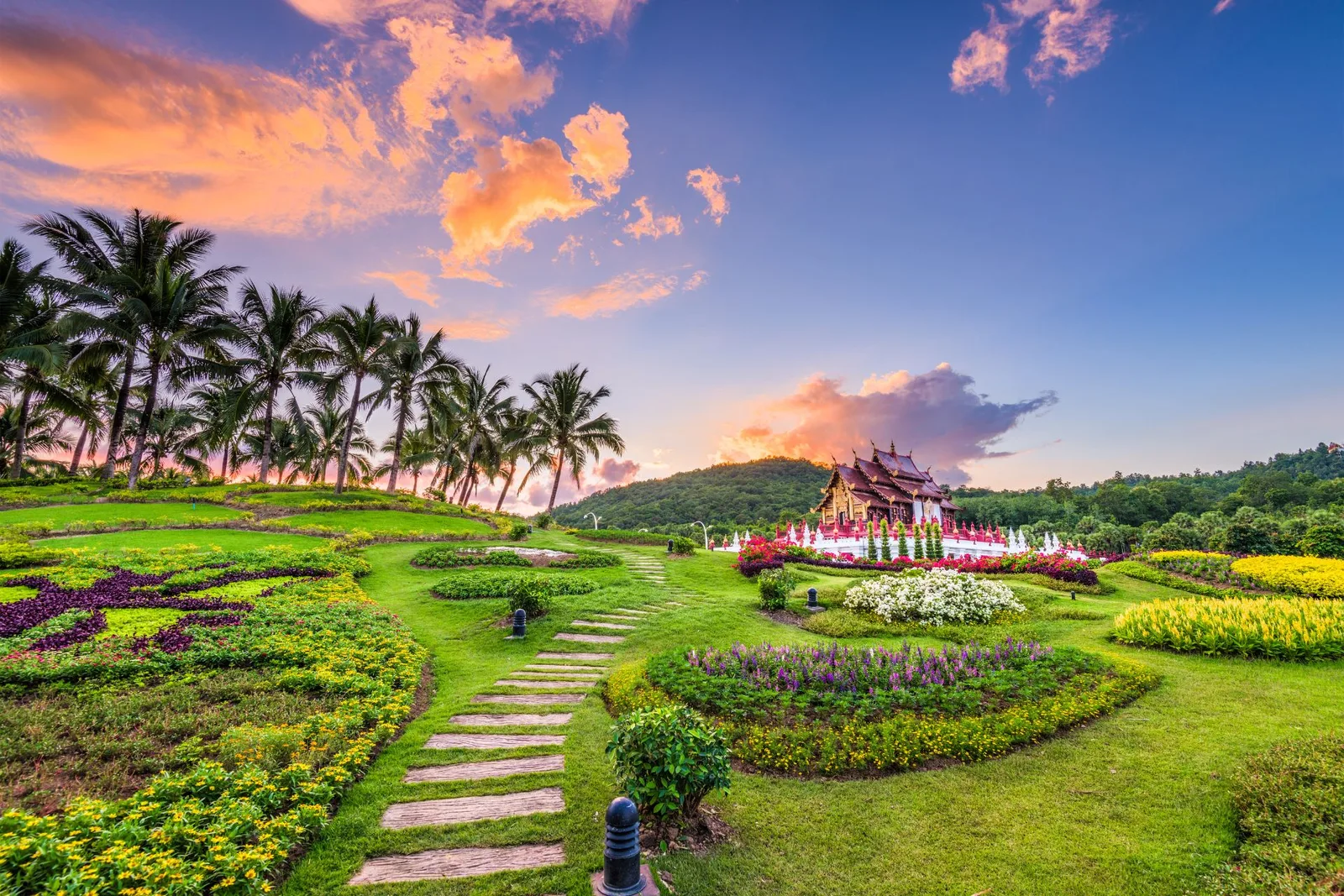
Stretching between the Indochinese peninsula, lush Malaysia and the Indonesian archipelagos, Thailand is a country that evokes the idea of the “Orient” more than most.
Known as the “land of smiles”, this country, which narrows like a funnel in the south and opens into wide spaces in the north, is one of the most fascinating and mysterious in Asia, the keeper of centuries-old traditions that still today animate and accompany the life of its peaceful people. In this article we set off to discover some of the customs and traditions of the local culture, seeking to unveil the dense mystery that surrounds this magnificent country.
The “Sawasdee”, a true philosophy of life
In Thailand, even a simple gesture such as a greeting becomes an intense experience, capable of encapsulating the essence of the country.
Here, as is often the case in other Eastern cultures, outward gestures reflect an attentiveness to the inner life of the person. In this way, they become genuine ceremonials of elegance, marked by kindness and by the smile.
The “wai”, the Thai greeting, may be taken as the symbol of this particular disposition of spirit, founded on sensitivity and empathy. Its gestures follow precise instructions, which may vary according to the social standing of the person addressed.
In general, the palms of the hands are gently pressed together, fingers pointing upwards. At the same moment, the head makes a quick bow: in that brief instant, the joined hands brush the chin and the forehead, following the movement of the head. A faint smile lights up the face, leaving a feeling that warms the heart. Entering shops or approaching the stalls, eating in a restaurant or simply catching the eye of men and women, it is usual to be welcomed with the “wai”. This is why it is much more than a simple greeting: it becomes a discreet and intimate hymn to hospitality, brotherhood and generosity.
The “Wat”, place of worship and school of life
Most of the attractions found in Thailand include the word “wat” in their name. It is a term which, in common usage, denotes the Buddhist temple.
In Thailand there are well over 30,000 wats, scattered across the whole country. By extension, the wat is an enclosed area within which stand various buildings, differing in form and function: the most important is the sacred temple itself, at the centre of all the most important religious ceremonies and home to the statue of the Buddha.
Around the temple are the quarters where the monks live, a school devoted to the study of the scriptures and doctrine, and other annexed buildings of various kinds.
The wat, like the monasteries of the Middle Ages, does not, however, serve a purely religious function. It is a gathering place for local communities, since within it one may also find shelters, small hospitals or even traditional markets.
The older monks are highly respected in the Thai social hierarchy. It falls to them to accompany every male Thai Buddhist into the monastery, for a variable period ranging from two to six months. Since these are sacred places, there is a series of rules of conduct to be observed inside the wats. For example, you must dress fairly soberly, remove your shoes before entering the sacred areas, refrain from touching the monks and, finally, avoid pointing the soles of your feet towards the sacred images, since the lower limbs are considered impure in the Buddhist tradition.
Loy Krathong, the evocative festival of lights
The seasons in Thailand follow the lunar calendar, and the most famous festivities are linked above all to Buddhist rituals. Among these, the most evocative, and the best known worldwide, is probably the “Loy Krathong Festival”.
This wonderful collective celebration takes place every year on varying dates, on the first full-moon night of the 11th lunar month, which almost always falls in November.
Locals and tourists crowd along waterways of every kind throughout the country, setting adrift hundreds of floats specially decorated with incense sticks, garlands of flowers, fruit, votive candles and a few coins.
It is a propitiatory gesture and an act of thanksgiving to the water deity and to the Buddha, said to date back more than 800 years, to the Sukhothai era.
And it is precisely in Sukhothai, Bangkok, Chiang Mai and Ayutthaya that the biggest crowds gather, armed with high-resolution cameras to capture the magic of the event. At dusk comes the most spectacular and moving moment of the whole festival: hundreds of lit lanterns are released into the sky, as an omen of prosperity and a wish for serenity and peace.
The age-old art of sacred tattoos
In the Indochina region, Thailand has remained the only country where the tradition of tattoos of sacred origin still survives.
Started by the celebrated Hollywood star Angelina Jolie, the idea of travelling to Thailand to get a tattoo has become almost a fashion.
In reality, this practice has its roots deep in the past: even today, in some ancient frescoes, one can see swords shattering on contact with the skin of tattooed men.
The dense web of symbols etched into the skin has in fact always served a function of protection against external dangers, conferring on anyone bearing tattoos a power beyond all expectation.
Getting a sacred tattoo, in Thailand, is a very serious matter, starting with the rigorous selection of the tattooist. Enter the “Ajarn”, the master tattooist, a monk expert in this kind of art, with whom the type of design is chosen.
Once the design has been chosen and executed, the Ajarn recites a series of prayers and mantras, with the aim of transferring energy and protection to the tattooed image. These powers are, however, temporary: that is why, periodically, roughly once a year, the operation should be repeated, to test the master’s magical power and pay him due tribute.
Thai dance, a spectacle of elegance and expressiveness
Dance is one of the most important activities in the social and artistic fabric of Thailand, a fascinating concentration of grace and colour.
Initially, performances were the preserve of an elite, reserved for the highly select, private circles of the court, as a form of entertainment for royalty and the courtiers who attended them.
Nowadays, dance performances are open to all and take place not only in theatres but also in restaurants and resorts throughout the country.
Among all the artistic variants in circulation, the “khon” is considered the classic expression of the national traditional dance. It is a form of dance that draws its inspiration from cycles of legends and myths of Indian origin, but which are widely known throughout South-East Asia.
The characters are human, but also animals, mythological beings and demons, whose stories symbolise the age-old struggle between good and evil. Accompanied by the gripping narration of an external storyteller, with wonderful costumes and choreography that is now slow, now more frenzied, the dance stages universal themes such as war, jealousy, love and friendship.
Muay Thai, the martial art of the “eight limbs”
Also known as Thai boxing or Siamese boxing, muay thai has its roots in “Muay Boran”, the ancient Thai fighting technique.
It arose as a purely defensive form of combat, to withstand the many attempted attacks and raids from neighbouring countries.
Muay thai involves eight points of contact, which is why it is also called “the art of eight limbs” or “the science of eight limbs”. It uses a wide range of techniques performed with the legs and arms. Like all Eastern martial arts, Muay Thai demands intense mental preparation, even before the physical kind. Great powers of concentration are required, which can be acquired only through targeted training sustained over time.
Why choose a Guiness Travel Tour
For us at Guiness, a journey is a wonderful frame of life.
Our aim is not to “show” places, but to accompany travellers as they immerse themselves fully in the culture and beauty of their chosen destination.
All our itineraries are 100% independently planned, carefully designed and tested for over 30 years, thus allowing the product to evolve constantly, reaching a high, wide-ranging cultural level and guaranteeing maximum comfort in the services on the ground.
This is why we created the Guiness Exclusive Tour:
a unique travel experience, mindful of sustainability and rich in experiences, designed to give you maximum comfort, leaving you free to think of nothing but enjoying the moment.
Every one of our trips comes with guaranteed extras:
- Tour leader departing from Italy and accompanying the group for the whole duration of the tour
- Exclusive departures with a limited number of places
- Departures possible from all over Italy
- 24-hour assistance on every departure
- Cancellation without penalty up to 45 actual days before departure
- No surprise extra costs on arrival
- Free minibar service on board the coaches (guaranteed in all the countries visited)
Click HERE and discover the Grand Tour of THAILAND
Click HERE and discover THAILAND & BEACHES
Team
Guiness Travel T.O.

'%3e%3cg id='Final-Copy-2_2_' transform='translate(1275.000000, 200.000000)'%3e%3cpath class='st0' d='M7.4,12.8h6.8l3.1-11.6H7.4C4.2,1.2,1.6,3.8,1.6,7S4.2,12.8,7.4,12.8z'/%3e%3c/g%3e%3c/g%3e%3c/g%3e%3cg id='final---dec.11-2020'%3e%3cg id='_x30_208-our-toggle' transform='translate(-1275.000000, -200.000000)'%3e%3cg id='Final-Copy-2' transform='translate(1275.000000, 200.000000)'%3e%3cpath class='st1' d='M22.6,0H7.4c-3.9,0-7,3.1-7,7s3.1,7,7,7h15.2c3.9,0,7-3.1,7-7S26.4,0,22.6,0z M1.6,7c0-3.2,2.6-5.8,5.8-5.8 h9.9l-3.1,11.6H7.4C4.2,12.8,1.6,10.2,1.6,7z'/%3e%3cpath id='x' class='st2' d='M24.6,4c0.2,0.2,0.2,0.6,0,0.8l0,0L22.5,7l2.2,2.2c0.2,0.2,0.2,0.6,0,0.8c-0.2,0.2-0.6,0.2-0.8,0 l0,0l-2.2-2.2L19.5,10c-0.2,0.2-0.6,0.2-0.8,0c-0.2-0.2-0.2-0.6,0-0.8l0,0L20.8,7l-2.2-2.2c-0.2-0.2-0.2-0.6,0-0.8 c0.2-0.2,0.6-0.2,0.8,0l0,0l2.2,2.2L23.8,4C24,3.8,24.4,3.8,24.6,4z'/%3e%3cpath id='y' class='st3' d='M12.7,4.1c0.2,0.2,0.3,0.6,0.1,0.8l0,0L8.6,9.8C8.5,9.9,8.4,10,8.3,10c-0.2,0.1-0.5,0.1-0.7-0.1l0,0 L5.4,7.7c-0.2-0.2-0.2-0.6,0-0.8c0.2-0.2,0.6-0.2,0.8,0l0,0L8,8.6l3.8-4.5C12,3.9,12.4,3.9,12.7,4.1z'/%3e%3c/g%3e%3c/g%3e%3c/g%3e%3c/g%3e%3c/svg%3e) Cookie preferences
Cookie preferences