

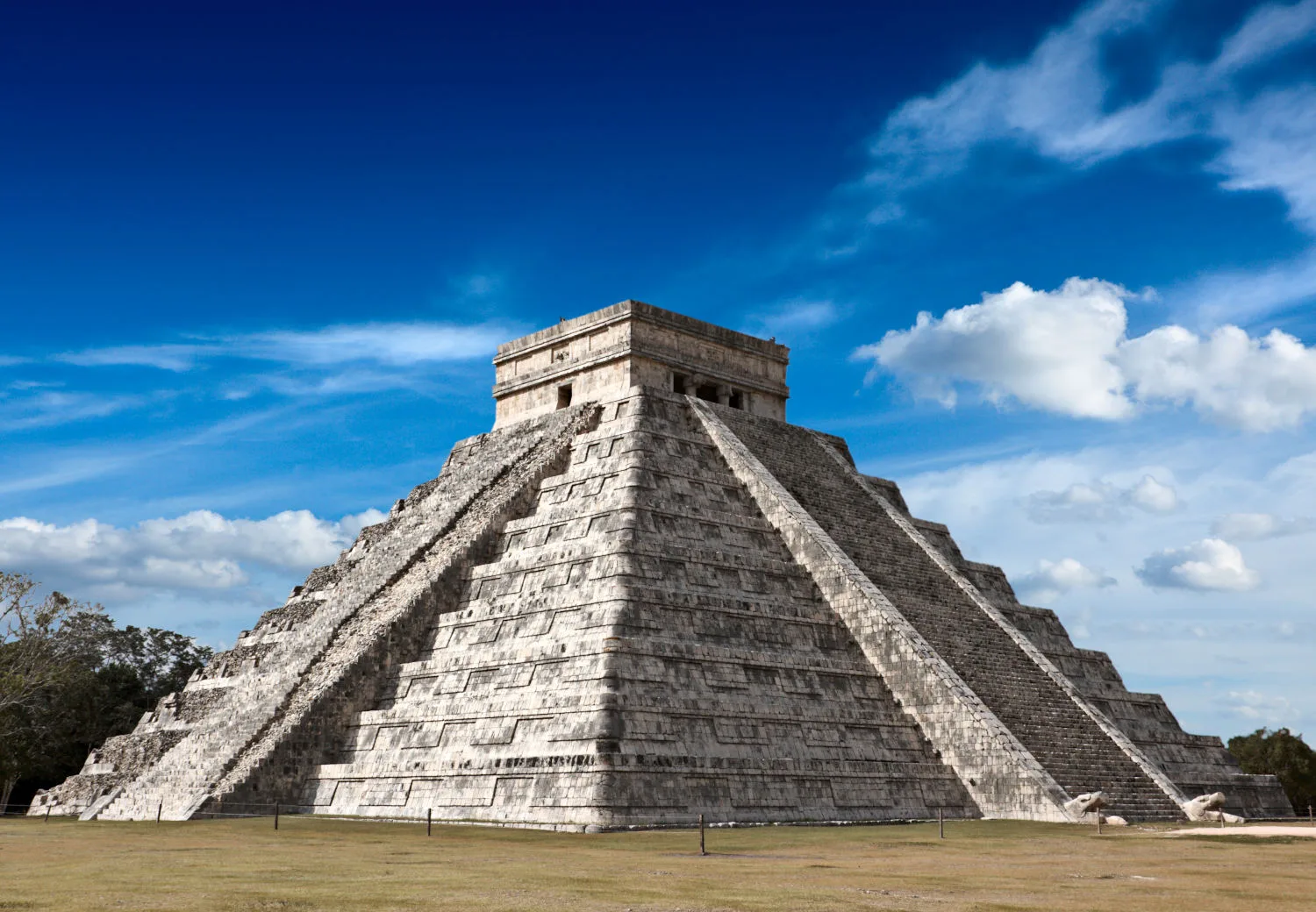
A journey to Mexico cannot fail to include a few stops at the most famous archaeological sites in Central America; Teotihuacan, Palenque, Uxmal, Chichen Itza are places that have become UNESCO World Heritage Sites and are visited by millions of people every year.
Standing before the celebrated stepped structures, it is impossible not to be impressed by their magnificence; walking among the remains of these ancient cities, among temples and pyramids, you can easily imagine how these places must have looked in antiquity.
Mexico’s archaeological sites bear witness to what has survived to the present day of the Maya and Aztec civilisations, the peoples who inhabited Mexico until the arrival of the Spanish “conquistadores”.
Their social system was complex and sophisticated and, above all, steeped in myths and beliefs, some of which still have a place in Mexican society today, particularly in the indigenous communities that have survived modernity. The charm of Mexico is, in fact, largely bound up with the many facets of its culture.
Between Maya gods and Aztec heroes
The mythological heritage of the Maya, which has come down to us mainly through the wall paintings that decorate the temples, encompasses all those beliefs and tales whose protagonists are the personified forces of nature, the gods and numerous heroes. As so often in ancient cultures, mythology is closely connected with the events of nature which, given their power, shaped everyday life. The relationship with the earth, the birth of the sun and the moon and the origin of certain animals formed the basis for the creation of stories and legends that were then handed down.
The people often felt the need to explain or “ward off” calamitous events that could endanger lives or harvests, such as epidemics. Indeed, it was the twins Hunahpu and Xbalanque who defeated the gods that brought disease and death. Similarly, it was the maize hero who defeated the gods of thunder and lightning, with whom he ended up making a pact to protect the harvest.
In Chiapas there circulated the story of a young boy and his elder brothers who, because of their jealousy, were turned into wild pigs of the forest; the youngest and his mother, instead, became the Sun and the Moon.
The supreme god of the Maya was the sun god, called Itzamna; he had invented writing and was the patron of that activity. Kukulcan was an equally important deity, usually depicted as a feathered serpent.
Among the other gods widely represented in the temples were the moon goddess, the maize god and the god of death.
Many Maya legends are linked to animal symbolism: certain animals in particular gave rise to a series of especially fascinating stories. One example is that of the hummingbird, considered the messenger between worlds: not only did it connect the human world with the divine, it was also able to carry messages from the world of the dead.
It was believed to be an animal that brought joy and good fortune, and anyone who tried to capture it was cursed by the gods.
Aztec mythology too, although different from that of the Maya, told the stories of gods who often personified elements of Nature; here again the bond with the natural world was very strong.
The stories of heroes, gods and animals were handed down for generations, creating an extremely rich and fascinating cultural heritage.
The most important Aztec deity was Quetzalcoatl, also known as the “feathered serpent”; tradition has it that he was a man with white skin and a long beard made of coloured feathers, good and endowed with the finest qualities. He had come from across the sea and had taught the Aztec people to grow maize, to construct buildings and to live by certain rules. Having brought these improvements to society, he had set off again by sea, promising to return; the Aztecs therefore awaited his return.
The god Quetzalcoatl was credited with having taught the Aztecs to cultivate chocolate: indeed, when he came to earth he had brought with him a precious cacao plant. It was from him that people learned to care for this divine plant: they knew how to gather its fruit and grind the seeds to create a magical dark drink.
The best way to get to know the pre-Columbian imagination is to visit the surviving archaeological sites, admiring in particular their many wall paintings. Guiness Travel organises guided visits inside the main Mexican sites, with groups accompanied by an expert local guide and the tour leader travelling with them from Italy.
Choose Guiness Travel’s tours
For Guiness Travel, travelling is an enriching experience to be savoured in every respect: so food, too, has its place. In all our itineraries every last detail is taken care of, including the places where you will eat.
All the itineraries in the catalogue are 100% independently planned and carefully designed and tested, allowing the product to evolve constantly and to reach a high, wide-ranging cultural standard.
This is why we created the Guiness Exclusive Tour, a unique travel experience, mindful of sustainability, that will give you considerable advantages:
- organisation;
- attention to detail;
- carefully selected services on the ground (designed to give you maximum comfort, leaving you free to think of nothing but enjoying the moment).
DISCOVER THE GRAND TOUR OF MEXICO
Team Guiness


'%3e%3cg id='Final-Copy-2_2_' transform='translate(1275.000000, 200.000000)'%3e%3cpath class='st0' d='M7.4,12.8h6.8l3.1-11.6H7.4C4.2,1.2,1.6,3.8,1.6,7S4.2,12.8,7.4,12.8z'/%3e%3c/g%3e%3c/g%3e%3c/g%3e%3cg id='final---dec.11-2020'%3e%3cg id='_x30_208-our-toggle' transform='translate(-1275.000000, -200.000000)'%3e%3cg id='Final-Copy-2' transform='translate(1275.000000, 200.000000)'%3e%3cpath class='st1' d='M22.6,0H7.4c-3.9,0-7,3.1-7,7s3.1,7,7,7h15.2c3.9,0,7-3.1,7-7S26.4,0,22.6,0z M1.6,7c0-3.2,2.6-5.8,5.8-5.8 h9.9l-3.1,11.6H7.4C4.2,12.8,1.6,10.2,1.6,7z'/%3e%3cpath id='x' class='st2' d='M24.6,4c0.2,0.2,0.2,0.6,0,0.8l0,0L22.5,7l2.2,2.2c0.2,0.2,0.2,0.6,0,0.8c-0.2,0.2-0.6,0.2-0.8,0 l0,0l-2.2-2.2L19.5,10c-0.2,0.2-0.6,0.2-0.8,0c-0.2-0.2-0.2-0.6,0-0.8l0,0L20.8,7l-2.2-2.2c-0.2-0.2-0.2-0.6,0-0.8 c0.2-0.2,0.6-0.2,0.8,0l0,0l2.2,2.2L23.8,4C24,3.8,24.4,3.8,24.6,4z'/%3e%3cpath id='y' class='st3' d='M12.7,4.1c0.2,0.2,0.3,0.6,0.1,0.8l0,0L8.6,9.8C8.5,9.9,8.4,10,8.3,10c-0.2,0.1-0.5,0.1-0.7-0.1l0,0 L5.4,7.7c-0.2-0.2-0.2-0.6,0-0.8c0.2-0.2,0.6-0.2,0.8,0l0,0L8,8.6l3.8-4.5C12,3.9,12.4,3.9,12.7,4.1z'/%3e%3c/g%3e%3c/g%3e%3c/g%3e%3c/g%3e%3c/svg%3e) Cookie preferences
Cookie preferences