

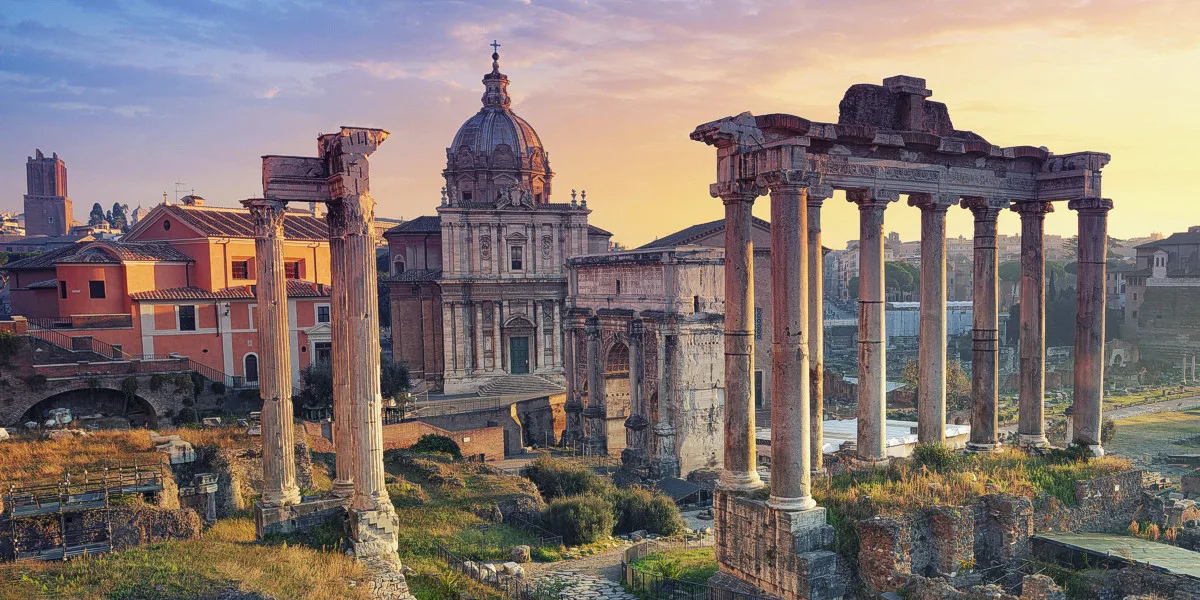
From the Dolomites to the Aeolian Islands, from the heart of Verona to that of Syracuse, by way of the Sassi of Matera and the excavations of Pompeii.
Crossing the Bel Paese to discover its marvellous UNESCO sites is a wonderful journey that unlocks the secrets of what Dante called «the garden of the empire».
Indeed, with 4,026 museums, 293 archaeological areas and parks and 570 monuments, Italy dominates every ranking for cultural and natural heritage.
For those who love travel and wish to get to know some of the sites on the World Heritage List, open but visitable by reservation, it is possible to choose from a wide range of itineraries, both crossing the UNESCO cities of Florence, Rome, Venice and Naples and discovering enchanting hidden gems that deserve a stop.
But it is not only Italy that is rich in UNESCO World Heritage. The Old Continent is full of surprises to explore: cities, villages, natural wonders and lesser-known little gems, all waiting to be discovered.
In fact, all over Europe there are World Heritage Sites that alone are worth the journey to an unfamiliar country.
The list of UNESCO wonders includes cities, national parks and architectural marvels: Europe has around 400 sites.
What is a UNESCO World Heritage site
UNESCO is an intergovernmental institution linked to the UN, the United Nations Organisation. It was founded in 1946 with the support of 44 countries.
Today UNESCO is known above all for the World Heritage List, that is, the List of World Heritage. In reality the organisation carries out many other tasks.
First of all, UNESCO is the acronym of “United Nations Educational, Scientific and Cultural Organization” – in Italian, “Organizzazione delle Nazioni Unite per l’Educazione, la Scienza e la Cultura”.
The organisation has always aimed at building peace: “building peace in the minds of men and women”.
Indeed, after the atrocities committed before and during the Second World War, many became aware that peace had to be preserved not only through treaties, but also (and above all) through knowledge of and respect for the culture of others.
Respect and knowledge are the cornerstones of civil society, the pivot that makes it possible to establish an open dialogue with cultures and countries different from one’s own.
Protecting and spreading the historical, scientific and cultural heritage of all member countries therefore helps to preserve peace and to create a melting pot of cultures and individuals.
This, first and foremost, is UNESCO’s mission.
Today the organisation is constantly engaged in promoting not only interculturality, but also the spread of culture itself, the protection of the environment and the defence of minorities. All this happens by planning events and initiatives that involve the various member states.
However, UNESCO is famous throughout the world for the “World Heritage List”. The list is extremely important, since it includes works that are the fruit of human ingenuity and/or of nature, whose knowledge and safeguarding is considered fundamental for all Humanity.
The list is constantly updated. To date, UNESCO counts 1,154 sites (897 cultural, 218 natural and 39 mixed) in 167 countries around the world.
The World Heritage List therefore includes works of art, archaeological sites and natural spaces to be preserved, known and conserved down the ages.
At present Italy holds the record for properties declared “World Heritage”, with no fewer than 58 scattered across the Bel Paese.
UNESCO World Heritage routes in Italy
In Italy alone the UNESCO World Heritage sites to visit are many, and of great artistic and cultural value.
So the first step that discerning travellers should take is to choose tour operators whose routes give prominence to these places of inestimable value.
The second step is certainly to choose routes that pass through the marvellous UNESCO World Heritage cities and that also venture off the usual tourist tracks.
For example, one might opt for the Prati della Burraia, one of the emblematic places of the Casentino Forests and the ancient beech forests of Sasso Fratino (a UNESCO site since 2017), between Romagna and Tuscany.
Along this road, in fact, you can admire the colours of the mosaics that make the vault of the little Mausoleum of Galla Placidia unique, and no fewer than 7 other UNESCO treasures which for centuries have made Ravenna the world capital of mosaics.
Along the way, a stop is a must to taste Fossa cheese and to reach Poppi and the Monastery of Camaldoli, where the Benedictine motto Ora et Labora still lives on in the Camaldolese congregation.
Alternatively, one could head towards Tarquinia, along what were once the Ways of Water: first to Orvieto with its spectacular Cathedral (with an obligatory detour to Sorano and Pitigliano, the towns of tufa), then to Bolsena with its “drinkable lake”, and on to Viterbo and the Terme dei Papi.
But it is when you arrive among the rock-cut tombs of Tarquinia that you are captivated by the age-old mysteries that still inhabit the necropolises.
The route from Tivoli to the Cilento National Park, crossing the Sannio, is also of inestimable charm.
Along the way, in fact, you can admire the magnificence of Hadrian’s Villa, a symbiosis of stone and nature, which together with the nearby Villa d’Este stages the splendours of ancient and Renaissance Rome.
Then, along the Sannio valley, you reach medieval Benevento with its Roman, Samnite and Lombard remains. After a long day at the Royal Palace of Caserta, a tribute to the majesty of the Bourbons with its palace and gardens that surpass those of Versailles, sunset brings you to Paestum to admire its majestic ruins.
From there, as far as Cala degli Infreschi, you are immersed in the magic of the Cilento National Park, among the ancient archaeological sites of Velia and the Charterhouse of Padula.
Admire the crystal-clear waters and protected marine areas, such as Punta Licosa and Capo Palinuro, and ancient seafaring villages such as Santa Maria di Castellabate, Acciaroli, Marina di Pisciotta and Pioppi, right there where the Mediterranean Diet was born (an Intangible Cultural Heritage of Humanity since 2010), to which the Living Museum in Palazzo Vinci is dedicated.
In short, the choices are many, the landscapes evocative and the artistic beauties priceless.
Choose Guiness Travel Tours
Guiness Travel is the tour operator most attentive to the choice of places and the well-being of travellers. Guiness’s philosophy has always been to conceive and create a journey that is a marvellous frame of life.
This is why our aim is not to “show” places, but to accompany travellers as they immerse themselves completely in the culture and beauty of the destination they have chosen.
In fact, most of our tours include a guided visit to the most evocative and important UNESCO World Heritage sites. These places of undeniable charm allow you to enjoy the cultural experience to the full.
According to our philosophy, travelling is an educational opportunity to be savoured in every pleasant moment, to feel pampered by our care and by every kind of comfort.
Indeed, at Guiness Travel we have always organised tours with the utmost respect for the environment and for the comfort of travellers: the only way to guarantee the well-being of participants and respect for the places visited is to open the tours only to a limited number of carefully selected participants.
All the itineraries in the catalogue are 100% independently planned and are carefully designed and tested, allowing the product to evolve constantly and reach a high, wide-ranging cultural level.
This is why we created the Exclusive Guiness Tour: a unique travel experience, attentive to sustainability, which will give you significant advantages:
- organisation;
- attention to detail;
- carefully selected services on the ground (designed to give you maximum comfort, leaving you free to think of nothing but enjoying the moment).
Thanks to the Exclusive Guiness Tour you will return home with a bag full of new and wonderful memories, immersed in the beauties of the world, thanks also to the many UNESCO World Heritage sites included in all our programmes.
In fact, in all our itineraries you can see immediately how many and which UNESCO sites you will be able to visit, thanks to an intuitive user-friendly icon in the catalogue.
This way, travellers know which UNESCO sites are included in their travel programme.
Team Guiness


'%3e%3cg id='Final-Copy-2_2_' transform='translate(1275.000000, 200.000000)'%3e%3cpath class='st0' d='M7.4,12.8h6.8l3.1-11.6H7.4C4.2,1.2,1.6,3.8,1.6,7S4.2,12.8,7.4,12.8z'/%3e%3c/g%3e%3c/g%3e%3c/g%3e%3cg id='final---dec.11-2020'%3e%3cg id='_x30_208-our-toggle' transform='translate(-1275.000000, -200.000000)'%3e%3cg id='Final-Copy-2' transform='translate(1275.000000, 200.000000)'%3e%3cpath class='st1' d='M22.6,0H7.4c-3.9,0-7,3.1-7,7s3.1,7,7,7h15.2c3.9,0,7-3.1,7-7S26.4,0,22.6,0z M1.6,7c0-3.2,2.6-5.8,5.8-5.8 h9.9l-3.1,11.6H7.4C4.2,12.8,1.6,10.2,1.6,7z'/%3e%3cpath id='x' class='st2' d='M24.6,4c0.2,0.2,0.2,0.6,0,0.8l0,0L22.5,7l2.2,2.2c0.2,0.2,0.2,0.6,0,0.8c-0.2,0.2-0.6,0.2-0.8,0 l0,0l-2.2-2.2L19.5,10c-0.2,0.2-0.6,0.2-0.8,0c-0.2-0.2-0.2-0.6,0-0.8l0,0L20.8,7l-2.2-2.2c-0.2-0.2-0.2-0.6,0-0.8 c0.2-0.2,0.6-0.2,0.8,0l0,0l2.2,2.2L23.8,4C24,3.8,24.4,3.8,24.6,4z'/%3e%3cpath id='y' class='st3' d='M12.7,4.1c0.2,0.2,0.3,0.6,0.1,0.8l0,0L8.6,9.8C8.5,9.9,8.4,10,8.3,10c-0.2,0.1-0.5,0.1-0.7-0.1l0,0 L5.4,7.7c-0.2-0.2-0.2-0.6,0-0.8c0.2-0.2,0.6-0.2,0.8,0l0,0L8,8.6l3.8-4.5C12,3.9,12.4,3.9,12.7,4.1z'/%3e%3c/g%3e%3c/g%3e%3c/g%3e%3c/g%3e%3c/svg%3e) Cookie preferences
Cookie preferences